


A fast-moving economy rewards people who keep their skills current, and the AI-500 exam is how you prove yours. GetValidTest supports that goal with 75 practice questions for the Microsoft Designing and Implementing Multi-Agent AI Solutions exam, maintained by experts who continuously supplement and adjust the bank as knowledge evolves.
Microsoft AI-500 Exam Syllabus Topics:
| Section | Weight | Objectives |
|---|---|---|
| Topic 1: Develop multi-agent solutions in Azure | 30–35% | - Manage state and memory
|
| Topic 2: Secure, govern, and deploy multi-agent solutions | 20–25% | - Deploy and maintain solutions
|
| Topic 3: Architect multi-agent solutions | 15–20% | - Design workflow and tool integration
|
| Topic 4: Evaluate, optimize, and monitor multi-agent solutions | 20–25% | - Assess performance and reliability
|
AI-500 Exam FAQ: What You Need to Know
Must hold Microsoft Certified: Azure AI Apps and Agents Developer Associate (obtained via Exam AI-103) to earn the certification; may take AI-500 before completing the prerequisite, but certification is only awarded after both requirements are met. Rules change occasionally, so verify the current requirements on the official Microsoft exam page before you schedule.
All three versions in a single purchase: 75 practice questions for the Microsoft Designing and Implementing Multi-Agent AI Solutions exam as a printable, expert-prepared PDF — ideal if you learn best by annotating paper; a Desktop Test Engine for Windows that simulates the real exam with two practice modes and works offline; and an Online Test Engine for any browser on Windows, Mac, Android, and iOS with test history and performance review. Use whichever version fits each moment, or all of them together. You also get a free demo, 365 days of free updates, a 50% renewal discount after the first year, and unlimited computer installations.
The AI-500 exam is a Microsoft certification exam validating the knowledge in the Microsoft Designing and Implementing Multi-Agent AI Solutions syllabus shown above. It belongs to these credential paths: Microsoft Certified: Azure AI Apps and Agents Developer Associate. Beyond theoretical knowledge, employers want demonstrated skills — and this credential provides that evidence in 2026's competitive market. GetValidTest helps you prepare with 75 practice questions in PDF, Desktop Test Engine, and Online Test Engine formats.
Online proctored or in-person at Pearson VUE test centers Registration for the Microsoft Designing and Implementing Multi-Agent AI Solutions exam runs through these official channels:
Your GetValidTest practice questions arrive by email within 1 minute of purchase, so preparation can begin the day you book.
The Microsoft Designing and Implementing Multi-Agent AI Solutions exam contains 50 to be completed within 100 minutes. That leaves limited time per question, so rehearsing under the same clock with the GetValidTest Desktop Test Engine is time well spent.
The official Microsoft Designing and Implementing Multi-Agent AI Solutions outline defines 4 domains. The top three are Secure, govern, and deploy multi-agent solutions (20–25%), Architect multi-agent solutions (15–20%), and Evaluate, optimize, and monitor multi-agent solutions (20–25%). See the full list in the topics section above — GetValidTest's 75 practice questions span every domain.
GetValidTest issues a full refund if you take the Microsoft Designing and Implementing Multi-Agent AI Solutions exam within 60 days of purchase and do not pass. The policy does not apply if the exam is taken within 3 days of purchase, if the exam was never actually taken, or to free materials or expired orders, and the candidate name must match the payer name. To claim, submit a scan of your enrollment slip and the official Score Report PDF within 2 days of the exam — processing takes up to 7 days. Alternatively, exchange for two free exam products of equal value while keeping your original product's update service. Delivery is by email within 1 minute; contact support if nothing arrives within 2 hours.
The Microsoft Designing and Implementing Multi-Agent AI Solutions exam requires 700 out of 1000 to pass, and registration costs $165 USD. A retake costs the same fee again — one more reason to gauge your readiness with the GetValidTest practice engines before exam day.
Microsoft recommends the following training for the Microsoft Designing and Implementing Multi-Agent AI Solutions exam:
Complement the official training with the 75 practice questions from GetValidTest — they show you whether the knowledge holds up under exam-style questioning.
Microsoft Designing and Implementing Multi-Agent AI Solutions Sample Questions:
You are designing a Microsoft Foundry multi-agent solution for claims processing. The design includes multiple specialized agents.
You need to specify the agent personas. scopes, boundaries, and autonomy levels. The solution must meet the following requirements:
* Provide a clear owner for conflicts between specialist agents.
* Validate agent outputs before downstream agents consume the outputs.
* Prevent specialist agents from invoking tools outside the assigned domain.
* Isolate each business domain so that adding a specialist agent affects only that domain.
What should you do?
- A. Define connected agents grouped by domain under a main agent, use natural-language delegation, and accept narrative summaries from the specialist agents.
- B. Define a claims hub that has direct specialist delegation, gate the final settlement output against a checklist, and route conflicts through the hub.
- C. Define domain-scoped sub-orchestrators under a claims supervisor, gate each output against a structured contract, and route conflicts through the supervisor.
- D. Define domain-scoped workflows that have local quality gates, publish the accepted results to a shared case state, and let the consuming domains resolve conflicts.
Correct Answer: C 🗳️
Explanation: Only visible for GetValidTest members. You can sign-up / login (it's free).
You have a Microsoft Foundry project that includes four independent analysis agents. Each agent invocation consumes 500 tokens per minute (TPM) from a Foundry deployment that has a TPM rate limit of 1,000.
After each agent completes, it writes 200 small records to Microsoft Dataverse. Running multiple agents simultaneously causes write bursts that result in HTTP 429 (Too Many Requests) responses.
You need to reduce the end-to-end task duration, while preventing provider and platform throttling. The solution must meet the following requirements:
* Keep as much agent parallelism as the TPM rate limit permits.
* Handle Dataverse throttling without sending premature retries.
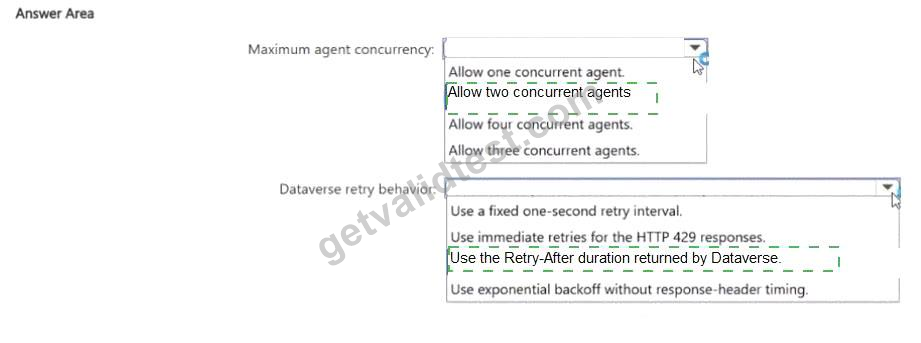
How should you configure the orchestration? To answer, select the appropriate options in the answer area.
NOTE: Each correct selection is worth one point.
Correct Answer:
Explanation:
Maximum agent concurrency: Two agents; Dataverse retry behavior: Respect the Retry-After duration returned by Dataverse.
Each analysis agent consumes 500 TPM and the deployment permits 1,000 TPM, so at most two agents can run simultaneously without exceeding the stated model limit. Running only one wastes available parallelism; running three or four violates the limit. The separate Dataverse problem is HTTP 429 service-protection throttling. Microsoft Dataverse returns a `Retry-After` duration that tells clients how long to wait before retrying. Respecting that value prevents premature retries from worsening the overload condition. A fixed retry interval or immediate retry ignores the server ' s current capacity signal. The orchestration should therefore cap model-side concurrency at two and, after each agent finishes, pace Dataverse writes according to the returned retry guidance. This combination minimizes task duration while honoring both provider and platform throttling constraints. At implementation time, the same rule should be expressed through the framework or service configuration rather than left only as a natural-language convention. That makes the behavior repeatable across runs, easier to test, and less sensitive to model variability.
Official Microsoft reference: Dataverse service protection API limits
You have a Microsoft Foundry multi-agent customer support solution. The solution includes an orchestrator that starts a single conversation trace when a user request arrives and can invoke two agents named Agent1 and Agent2 concurrently. Each agent can invoke Model Context Protocol (MCP)-hosted tools and dependent REST APIs.
The solution uses OpenTelemetry SDKs to emit logs, metrics, and traces via OTLP to an OpenTelemetry Collector. The solution emits the conversation ID, trace ID, and span ID for agent invocations, tool invocations, and external API calls.
You have a monitoring dashboard that includes:
* Latency
* Throughput
* Reliability
* Token usage
* Content safety triggers
* Time to First Token (TTFT)
Alert rules are configured for latency anomalies and tool invocation failures.
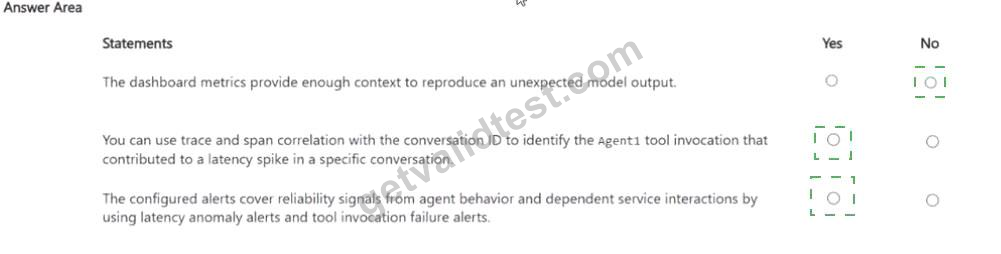
For each of the following statements, select Yes if the statement is true. Otherwise, select No.
NOTE: Each correct selection is worth one point.
Correct Answer:
Explanation:
No / Yes / Yes
Aggregate dashboard metrics do not provide enough execution context to reproduce a specific unexpected model output, so the first statement is false. Reproduction normally requires detailed trace data such as model inputs/outputs, ordered agent spans, tool calls, and dependency results. The second statement is true because the solution emits conversation, trace, and span identifiers across agent, MCP tool, and REST API calls.
OpenTelemetry correlation can therefore isolate the Agent1 tool span that contributed to a latency spike in one conversation. The third statement is also true: latency-anomaly alerts and tool-invocation failure alerts cover important reliability signals from both agent execution and dependent service interactions. They are not the entire observability strategy, but they do address the reliability conditions described. The correct sequence is No, Yes, Yes. The evaluation should also preserve correlation identifiers and version information where possible so a failed score can be traced back to the exact agent, model, tool call, or retrieval step that produced it. This turns the metric into an actionable diagnostic rather than only a dashboard number.
Official Microsoft reference: Microsoft Foundry - agent tracing concepts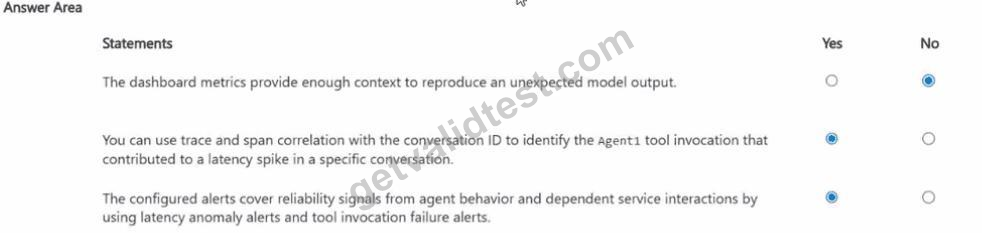
You have a Microsoft Foundry multi-agent solution. The solution includes a parent agent that can call an Azure logic app and delegate to two subagents.
You need to implement a review process for flagged interactions. The solution must meet the following requirements;
* Identify requests that call third-party services.
* Moderate the prompts, steps, and tool calls.
* Include a governance review.
What should you do?
- A. Route subagent findings to compliance reviewers, correlate the parent and subagent. and require approval for only the final parent-agent message.
- B. Submit the requests by using central sensitive-use intake, enable guardrails and traces, and require reviewers to approve, edit, or reject messages.
- C. Run agent evaluators during CI/CD, require a reviewer to approve the release, and collect production transcripts for sensitive-use intake after the pilot.
- D. Use Foundry Content Safety to prioritize sensitive messages for moderators, require moderator approval for final responses, and allow selected calls to proceed automatically.
Correct Answer: B 🗳️
Explanation: Only visible for GetValidTest members. You can sign-up / login (it's free).
You have a Microsoft Foundry project that contains an incident triage agent.
You have a Model Context Protocol (MCP) server registered in the organizational tool catalog. The MCP server exposes two tools named docs_search and deployment_delete.
You need to ensure that the agent can only invoke docs_search.
What should you configure?
- A. the agent tool configuration
- B. the project details
- C. the agent instructions
- D. the agent run configuration
Correct Answer: A 🗳️
Explanation: Only visible for GetValidTest members. You can sign-up / login (it's free).
Viewing page 1 out of 15 pages.
Viewing questions 1-5 out of 75 questions.


