


2025 Provide Updated NVIDIA NCA-GENM Dumps as Practice Test and PDF
NCA-GENM Dumps are Available for Instant Access
NEW QUESTION # 20
You are experimenting with different architectures for a text-to-speech (TTS) model. You have implemented a Tacotron 2 model and a FastSpeech 2 model. Which of the following statements accurately describes the key differences between these two architectures and their implications?
- A. Tacotron 2 is an autoregressive model, while FastSpeech 2 is a non-autoregressive model. This allows FastSpeech 2 to generate speech in parallel, resulting in significantly faster inference speeds.
- B. Both Tacotron 2 and FastSpeech 2 use attention mechanisms, but FastSpeech 2 incorporates length regulator and variance adaptor modules to address the one-to-many mapping problem, leading to more stable and controllable synthesis.
- C. FastSpeech 2 uses an attention mechanism for aligning text and speech, while Tacotron 2 relies on a fixed alignment, resulting in faster training and inference for Tacotron 2 but potentially lower quality.
- D. Both Tacotron 2 and FastSpeech 2 rely on fixed alignments, but FastSpeech 2 uses a more complex decoder architecture, leading to higher quality but slower inference.
- E. Tacotron 2 uses an attention mechanism for aligning text and speech, while FastSpeech 2 relies on a fixed alignment, resulting in faster training and inference for FastSpeech 2 but potentially lower quality.
Answer: A,B
Explanation:
Tacotron 2 is an autoregressive model that uses an attention mechanism for aligning text and speech, whereas FastSpeech 2 is a non-autoregressive model, generating speech in parallel for faster inference. FastSpeech 2 also addresses the one-to-many mapping problem (one phoneme can have different durations) with length regulator and variance adaptor modules, improving stability and controllability. A is incorrect because attention based Tacotron 2 is slow to train and infer. B and D are incorrect becuase Tacotron 2 architecture has attention mechanism.
NEW QUESTION # 21
Consider a scenario where you are training a multimodal Generative A1 model using both image and text dat a. The image data is stored in a directory with millions of high-resolution images, and the text data is in a large CSV file. What is the MOST efficient way to load and preprocess this data for training, minimizing memory usage and maximizing throughput?
- A. Use a distributed file system to store the data and load it directly into the model during training.
- B. Resize all images to a very small size before loading them into memory.
- C. Load all images and text data into memory at once, preprocess them, and then feed them to the model.
- D. Use a data generator (e.g., TensorFlow's 'tf.data.Dataset' or PyTorch's *DataLoadeN) to load and preprocess data in batches.
- E. Convert all images to a single large video file and load it into memory along with the text data.
Answer: D
Explanation:
Data generators are the most efficient way to handle large datasets because they load and preprocess data in batches, minimizing memory usage. Option A is infeasible for large datasets. Option C is not a standard or efficient approach. Option D is relevant for distributed training but doesn't address the memory issue of loading the entire dataset. Option E reduces memory usage but may sacrifice important image details.
NEW QUESTION # 22
Which of the following are valid methods for addressing the vanishing gradient problem in deep neural networks?
- A. Increasing the learning rate.
- B. Using batch normalization.
- C. Using ReLU (Rectified Linear Unit) activation functions.
- D. Using sigmoid activation functions.
- E. Employing skip connections (e.g., in ResNets).
Answer: B,C,E
Explanation:
ReLU avoids saturation like sigmoid, helping gradients flow. Skip connections provide alternative pathways for gradients. Batch normalization stabilizes learning and can help mitigate vanishing gradients. Increasing learning rate is unrelated, and sigmoid exacerbates the problem due to saturation.
NEW QUESTION # 23
You are building a multimodal Generative AI system to generate marketing content. You have text descriptions of products, images of the products, and customer reviews. Which of the following strategies would best handle potential inconsistencies or contradictions between these different modalities?
- A. Prioritizing the image data as images are the most visually appealing and engaging.
- B. Training separate models for each modality and then averaging the outputs.
- C. Ignoring customer reviews as they are often unreliable.
- D. Using a simple averaging method to combine the features from each modality.
- E. Employing an attention mechanism or a cross-modal fusion network that learns to weigh the importance of each modality based on the context.
Answer: E
Explanation:
Employing an attention mechanism or a cross-modal fusion network allows the model to dynamically learn which modalities are most relevant for a given input or generation task. This helps in resolving inconsistencies by giving more weight to reliable modalities and diminishing the influence of less reliable ones. Simple averaging or prioritization can lead to suboptimal results when modalities contradict each other.
NEW QUESTION # 24
You are building a generative AI model that creates realistic product designs based on textual descriptions and a reference image depicting a similar, but not identical, product. You are using a Variational Autoencoder (VAE) architecture. However, the generated images lack the fine-grained details present in the reference image. Which of the following methods would be most suitable to incorporate fine-grained details from the reference image into the generated design?
- A. Replace the VAE with a Generative Adversarial Network (GAN).
- B. Reduce the batch size during training.
- C. Implement a skip connection from the encoder of the reference image to the decoder of the generative model, allowing the decoder to directly access features from the reference image at multiple scales.
- D. Increase the latent space dimensionality of the VAE.
- E. Use a larger convolutional kernel Size in the decoder
Answer: C
Explanation:
Skip connections are designed to pass information from earlier layers to later layers, preserving fine-grained details. In this multimodal scenario, skip connections from the reference image encoder allow the generator to directly access and utilize those details. Increasing latent space dimensionality might capture more information, but doesn't guarantee fine-grained detail transfer. Larger kernels can blur details. Reducing batch size helps with generalization but doesn't directly address detail transfer. GANs might generate sharper images, but lack the explicit control over detail transfer that skip connections provide.
NEW QUESTION # 25
You are developing a multimodal system for medical diagnosis using MRI images and patient history text. Your initial model performs poorly on patients with rare conditions. Which of the following data augmentation techniques would be MOST effective in improving the model's performance on these under-represented cases?
- A. Replacing named entities in the patient history text with other random entities-
- B. Adding Gaussian noise to the pixel values of MRI images.
- C. Randomly cropping and rotating MRI images.
- D. Using a Generative Adversarial Network (GAN) to synthesize new MRI images conditioned on the patient history text, specifically targeting the rare conditions-
- E. Back-translating the patient history text to generate paraphrased versions-
Answer: D
Explanation:
Using a GAN to synthesize new data specifically for rare conditions is the most effective option. It directly addresses the class imbalance problem by creating more examples of the under-represented cases, conditioned on both the image and text modalities. While random image augmentations (AD) and text paraphrasing (B) can help, they don't directly target the rare conditions. Entity replacement could change the meaning of the history.
NEW QUESTION # 26
You're building a real-time voice cloning application using NVIDIA Riv
a. You need to ensure high-quality synthesized speech with minimal latency. Which of the following Riva configurations would provide the BEST trade-off between quality and speed?
- A. Using only the open source implementation and not NVIDIA Riva to implement a Voice Cloning application
- B. Using a large, transformer-based text-to-speech model with aggressive quantization and pruning, deployed on a cloud-based TPIJ instance.
- C. Using a pre-trained, open-source text-to-speech model and a CPU-based vocoder, optimized for minimal memory footprint.
- D. Using a large, high-capacity Tacotron 2 text-to-speech model and a high-resolution WaveGlow vocoder, deployed on a single, low-power GPU.
- E. Using a smaller, faster FastSpeech text-to-speech model and a parallel WaveGAN vocoder, deployed on a multi-GPU server with TensorRT optimization enabled.
Answer: E
Explanation:
FastSpeech and parallel WaveGAN offer a good balance of speed and quality. Multi-GPU deployment and TensorRT optimization further reduce latency. Tacotron 2 and WaveGlow (A) provide higher quality but are slower. CPU-based vocoders (C) are generally too slow for real-time applications. TPIJs (D) are not directly supported by Riva. (E) does not leverage Riva features. Riva's TensorRT optimizatins would be ideal here. The best option would be a faster TTS model along with a Vocoder for real time synthesis.
NEW QUESTION # 27
You are building a multimodal generative AI model to create personalized travel itineraries based on user preferences. The input data consists of text reviews of hotels, images of landmarks, audio clips of local music, and time-series data of weather patterns. Which of the following data curation techniques are MOST critical to ensure the quality and coherence of the final itinerary?
- A. Image captioning of landmarks to provide textual descriptions for the itinerary.
- B. Temporal alignment of weather data with travel dates to suggest suitable activities.
- C. Prioritizing the most recent reviews, regardless of their content.
- D. All of the above.
- E. Sentiment analysis of text reviews to rank hotels based on positive feedback.
Answer: D
Explanation:
All the options are critical. Sentiment analysis helps rank hotels, image captioning provides descriptions, and temporal alignment ensures activities are weather-appropriate. Ignoring any of these aspects would negatively impact the quality of the personalized itinerary.
NEW QUESTION # 28
You are deploying a Riva-based speech-to-text service in a production environment. You observe high latency and CPU utilization on your server Which of the following actions would be most effective in optimizing the performance of your Riva service?
- A. Deploying the Riva server on a CPU-only instance to reduce cost.
- B. Switching to a smaller, less accurate ASR model to reduce computational load.
- C. Disabling automatic punctuation and capitalization to simplify the ASR process.
- D. Enabling batching and concurrency in the Riva server configuration to process multiple requests simultaneously.
- E. Increasing the audio chunk size sent to the Riva server to reduce the number of requests.
Answer: D
Explanation:
Enabling batching and concurrency is a key optimization strategy for Riva. It allows the server to process multiple audio streams simultaneously, maximizing GPU utilization and reducing overall latency. Switching to a smaller model (A) might reduce load but also decreases accuracy. Disabling punctuation (C) has a minor impact. Increasing audio chunk size (D) can help, but batching is more significant. Deploying on CPU (E) negates the benefits of Riva's GPU acceleration.
NEW QUESTION # 29
You are building a system that translates sign language videos into spoken text. You have a dataset of videos and corresponding text transcriptions. You notice that the test data contains significant variations in lighting conditions and camera angles compared to the training dat a. Which of the following techniques would be MOST effective in addressing this domain shift and improving the generalization of your model?
- A. Fine-tune the model on a small subset of the test data to adapt to the specific characteristics of the test distribution.
- B. Reduce the size of the model to prevent overfitting to the training data.
- C. Apply aggressive data augmentation techniques to the training data, including random crops, rotations, and color jittering to simulate the variations in the test data.
- D. Use a domain adaptation technique such as Domain Adversarial Neural Networks (DANN) to learn domain-invariant features.
- E. Only evaluate on a subset of the test data that closely resembles the training data.
Answer: D
Explanation:
Domain adaptation techniques (C) are specifically designed to address domain shift by learning features that are invariant to the source and target domains. Data augmentation (A) can help but might not be sufficient. Fine-tuning on test data (B) is data leakage and invalidates the test set. Reducing model size (D) may not address the core issue of domain shift. Selecting a subset of the test data (E) defeats the purpose of testing generalization.
NEW QUESTION # 30
You are working on a project to generate realistic images from text descriptions. You've trained a diffusion model, but the generated images often lack fine-grained details and exhibit artifacts. Which of the following techniques would be MOST effective in improving the image quality and fidelity?
- A. Increase the number of diffusion steps during image generation.
- B. Use a larger batch size during training.
- C. Implement classifier-free guidance, adjusting the guidance scale to balance fidelity and diversity.
- D. Reduce the learning rate during training.
- E. None of the above.
Answer: C
Explanation:
Classifier-free guidance allows you to control the influence of the text description on the generated image. By adjusting the guidance scale, you can find a balance between generating images that are faithful to the text description and generating diverse and high-quality images. Increasing diffusion steps, batch size, or reducing the learning rate may help but is less targeted towards improving fidelity specifically.
NEW QUESTION # 31
Consider a multimodal emotion recognition system that uses both facial expressions (images) and speech (audio). You want to fuse the information from these two modalities at the decision level. Which of the following techniques would be MOST suitable for decision-level fusion?
- A. Train separate classifiers for images and audio, then average their output probabilities for each emotion class.
- B. Train a single transformer to process both images and audio in sequence.
- C. Train separate classifiers for images and audio, then use the output of the image classifier as input to the audio classifier-
- D. Train separate classifiers for images and audio, then use a weighted average of their output probabilities based on the confidence scores of each classifier.
- E. Concatenate the feature vectors extracted from the images and audio, then train a single classifier.
Answer: D
Explanation:
Weighted averaging allows you to give more weight to the modality that is more reliable or confident in its prediction for a given input. Simply averaging treats all modalities equally. Concatenation is feature-level fusion. The image classifier as input to audio classifier is a specific cascade approach. Using a single transformer is possible, but less common for decision fusion specifically. It is feature level fusion.
NEW QUESTION # 32
You're developing a system that translates spoken language into sign language animations. Which of the following losses would be MOST suitable for training the model to generate realistic and accurate sign language sequences from speech input?
- A. A combination of MSE loss for joint positions and a temporal smoothness loss to encourage smooth transitions between sign language poses.
- B. Cosine Similarity loss between audio embeddings and sign language animation embeddings.
- C. Cross-entropy loss between the predicted sign language sequence and the ground truth sequence.
- D. Mean Squared Error (MSE) loss between the predicted joint positions of the sign language character and the ground truth joint positions.
- E. Binary Cross entropy to classify the output sign animation-
Answer: A
Explanation:
MSE loss ensures accurate joint positioning, while the temporal smoothness loss prevents jerky and unnatural movements. Cross-entropy is suitable for classification tasks, not continuous sequence generation. Cosine Similarity between embeddings might encourage general alignment, but doesn't guarantee accurate pose reproduction and Binary Cross entropy is only good for Binary Classification tasks.
NEW QUESTION # 33
You are analyzing a dataset of customer reviews for a new product using Natural Language Processing (NLP). The dataset contains both positive and negative reviews, but a significant portion of the negative reviews uses sarcasm. Which of the following NLP techniques would be MOST effective in accurately identifying the sentiment expressed in sarcastic reviews?
- A. Using a rule-based system that identifies keywords associated with positive or negative sentiment.
- B. Sentiment lexicon-based approach.
- C. Bag-of-words model with TF-IDF weighting.
- D. Calculating the average word embedding for each review.
- E. Fine-tuning a pre-trained transformer model (e.g., BERT, RoBERTa) on a dataset of sarcastic and non-sarcastic reviews.
Answer: E
Explanation:
Pre-trained transformer models capture contextual information and complex relationships between words, which is crucial for detecting sarcasm. Bag-of-words, sentiment lexicons, and rule-based systems rely on individual words or simple patterns and are easily fooled by sarcasm. Averaging word embeddings loses the contextual information vital for sarcasm detection.
NEW QUESTION # 34
Consider a scenario where you're building a multimodal model to generate image captions. You've pre-trained a large language model (LLM) on a massive text corpus and a convolutional neural network (CNN) on ImageNet. How would you effectively combine these pre- trained components for your image captioning task, considering the need to maintain high caption quality and training efficiency?
- A. Train the CNN and LLM separately on unrelated datasets and then combine them at inference time using a simple averaging of their outputs.
- B. Freeze the CNN, extract image features, and train the LLM to generate captions from these features.
- C. Use a transformer-based encoder to process both image features and text embeddings before feeding them to the LLM decoder.
- D. Fine-tune both the CNN and the LLM jointly on the image captioning dataset.
- E. Freeze the LLM, train the CNN to predict text embeddings, and then decode these embeddings into captions.
Answer: C,D
Explanation:
Fine-tuning both the CNN and LLM jointly allows the model to adapt both visual feature extraction and language generation to the specific task of image captioning, leading to potentially higher quality captions. However, this can be computationally expensive. Using a transformer-based encoder to process both modalities before the LLM decoder allows for effective cross-modal attention and fusion, which is also a strong approach. Freezing either the CNN or LLM limits the model's ability to adapt. Training separately and averaging outputs is unlikely to produce coherent captions.
NEW QUESTION # 35
You are building a text-to-image application using CLIP. You notice that the generated images often lack specific details mentioned in the text prompt. Which of the following techniques would be most effective in improving the fidelity and detail of the generated images, given the limitations of CLIP's text encoder?
- A. Applying prompt engineering techniques such as adding descriptive adjectives and context to the text prompt and fine-tuning the prompt with iterative feedback.
- B. Increasing the temperature parameter of the diffusion model used in conjunction with CLIP to introduce more randomness and potentially more detail.
- C. Reducing the number of training steps for the diffusion model to prevent overfitting to the training data and promote generalization.
- D. Training a custom text encoder from scratch with a larger dataset specifically tailored to your application's domain.
- E. Using a larger image decoder network with more parameters to add detail during the image generation process.
Answer: A
Explanation:
Prompt engineering is the most practical and effective method for improving the fidelity of text-to-image generation with CLIP, without requiring extensive retraining or architecture changes. By carefully crafting and refining the text prompt, you can guide the generation process to produce images that more accurately reflect the desired details. Training a custom text encoder (A) is resource-intensive. While a larger image decoder (B) might help, it doesn't address the core issue of accurately capturing the prompt's meaning. Increasing temperature (D) can add randomness but not necessarily detail. Reducing training steps (E) could worsen performance.
NEW QUESTION # 36
You're fine-tuning a pre-trained multimodal model for a specific downstream task. You notice that while the model's performance on the training data is excellent, it performs poorly on unseen dat a. What regularization technique, beyond standard weight decay, is MOST likely to improve the model's generalization ability in this scenario, and what is its purpose?
- A. Gradient Clipping: To prevent exploding gradients, stabilizing training.
- B. Dropout: To randomly deactivate neurons during training, preventing co-adaptation and improving robustness.
- C. Early Stopping: To halt training when performance on a validation set degrades.
- D. Batch Normalization: To accelerate training and reduce internal covariate shift.
- E. Layer Normalization: To normalize activations across features, stabilizing training.
Answer: B
Explanation:
Dropout is particularly effective at preventing co-adaptation of neurons, forcing the model to learn more robust and independent features. This directly combats overfitting, leading to improved generalization. While Batch and Layer Normalization help with training stability, they don't directly address overfitting as effectively as Dropout. Early Stopping is a good practice, but doesn't actively regularize during training. Gradient clipping addresses training stability, not generalization.
NEW QUESTION # 37
When experimenting with different architectures for a text-to-image model, you observe that a Diffusion model generates higher quality images than a GAN (Generative Adversarial Network). However, the Diffusion model is significantly slower to generate images. What strategy can you employ to improve the inference speed of the Diffusion model without significantly sacrificing image quality?
- A. Employ distillation techniques to train a faster, smaller model.
- B. Train the GAN for a longer duration.
- C. Increase the number of diffusion steps.
- D. Use a smaller batch size.
- E. Use a larger UNet architecture within the Diffusion model.
Answer: A
Explanation:
Model distillation involves training a smaller, faster 'student' model to mimic the behavior of a larger, slower 'teacher' model. This allows you to retain much of the quality of the original model while significantly improving inference speed. Increasing the number of diffusion steps or using a larger UNet would further slow down the Diffusion model. Training the GAN longer doesn't address the speed issue of the Diffusion model. Using a smaller batch size might help with memory limitations, but won't significantly improve inference speed.
NEW QUESTION # 38
Consider the following Python code snippet that utilizes a pre-trained language model from the Hugging Face Transformers library: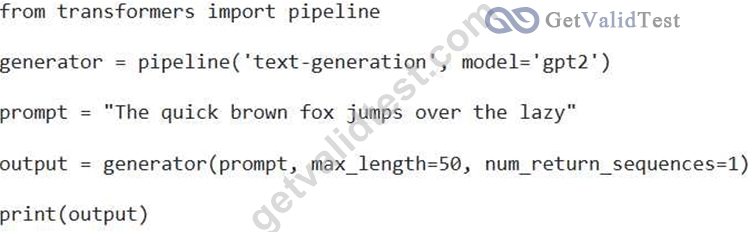
Which of the following statements are TRUE regarding the generated output?
- A. The output will contain a single sequence of text generated by the GPT-2 model, starting with the provided prompt.
- B. The output will always be exactly 50 tokens long.
- C. The parameter controls the number of different completion the model should return.
- D. The output will always start with "The quick brown fox jumps over the lazy".
- E. The GPT-2 model is guaranteed to generate grammatically correct and factually accurate text.
Answer: A,C,D
Explanation:
The code uses the Hugging Face Transformers pipeline to generate text using the GPT-2 model. The 'max_length' parameter sets the maximum length of the generated sequence, but the model may stop generating earlier if it reaches a natural stopping point. num_return_sequences' controls the number of sequences that return. Pre-trained language models are not guaranteed to be grammatically perfect or factually accurate. The output always includes the prompt.
NEW QUESTION # 39
You are fine-tuning a pre-trained multimodal model for a new task. You have limited computational resources. Which of the following fine-tuning strategies would be the MOST computationally efficient while still achieving good performance?
- A. Freeze all layers except the classification head and fine-tune only the classification head.
- B. Fine-tune all the layers of the model.
- C. Train a new random model from scratch for the task, which will avoid the need to load the pre-trained model.
- D. Randomize the model to train, if it improves the training rate.
- E. Freeze the lower layers of the model and fine-tune the upper layers and the classification head.
Answer: E
Explanation:
Freezing the lower layers and fine-tuning the upper layers and classification head strikes a balance between computational efficiency and performance. The lower layers typically capture more general features that are less specific to the task, while the upper layers capture more task-specific features. Freezing the lower layers reduces the number of trainable parameters, making the fine-tuning process more computationally efficient. Fine-tuning all layers is computationally expensive, freezing all layers except the classification head might not be sufficient for adapting to the new task, and training from scratch does not leverage the knowledge learned during pre-training. Randomizing model is not a general practice.
NEW QUESTION # 40
You are tasked with fine-tuning a pre-trained multimodal model for a new task involving image and text inputs. The pre-trained model was trained on a large dataset of image-caption pairs. Which of the following strategies would be MOST effective for transfer learning in this scenario, considering computational efficiency and performance?
- A. Use knowledge distillation to transfer knowledge from the pre-trained model to a smaller, more efficient model.
- B. Fine-tune all layers of the pre-trained model with a very small learning rate.
- C. Fine-tune a subset of layers, specifically those responsible for feature extraction from both image and text modalities, while keeping the lower layers frozen.
- D. Train a new model from scratch on the new task's dataset.
- E. Fine-tune only the classification head (output layer) while freezing all other layers of the pre-trained model.
Answer: C
Explanation:
Option C is the most effective strategy. Fine-tuning a subset of layers allows the model to adapt to the new task while leveraging the pre-trained knowledge. Freezing the lower layers preserves the general features learned from the large dataset, while fine-tuning the feature extraction layers allows the model to learn task-specific features. Fine-tuning all layers (Option B) can lead to overfitting and is computationally expensive. Freezing all layers except the classification head (Option A) may not provide sufficient adaptation. Training from scratch (Option D) is computationally expensive and requires a large dataset. Knowledge distillation (Option E) is also a valid option but may not be the most direct approach for transfer learning when the pre-trained model's architecture is suitable.
NEW QUESTION # 41
Consider you are working on a project that aims at generating photorealistic images from segmentation maps, using a conditional GAN architecture. The training process is unstable, frequently exhibiting mode collapse and artifacts. Describe a series of techniques, ranked by their likely impact, to mitigate these issues.
- A. 1. Switch to a Transformer-based architecture. 2. Use a larger dataset. 3. Decrease the number of channels in the generator.
- B. 1. Implement Spectral Normalization. 2. Use PatchGAN discriminator. 3. Apply data augmentation (e.g., random flips, jitter).
- C. 1. Reduce the number of layers in the discriminator. 2. Increase the learning rate of the generator. 3. Disable batch normalization.
- D. 1. None of the above
- E. 1. Increase batch size. 2. Decrease learning rate. 3. Add more convolutional layers.
Answer: B
Explanation:
Spectral Normalization stabilizes training by limiting the Lipschitz constant of the discriminator. PatchGAN discriminator focuses on local image patches, improving detail and reducing artifacts. Data augmentation increases the diversity of training data and improves generalization. Thus, Option B presents the most impactful techniques, ranked appropriately. Other options either suggest less impactful techniques or recommend steps that could worsen the issues. Mode Collapse can be avoided here with data augmentation.
NEW QUESTION # 42
......
Updated NCA-GENM Dumps Questions For NVIDIA Exam: https://troytec.getvalidtest.com/NCA-GENM-brain-dumps.html