


[2026] Pass ECCouncil 212-82 Test Practice Test Questions Exam Dumps
Verified 212-82 dumps Q&As - 212-82 dumps with Correct Answers
ECCouncil 212-82 Certification Exam is a comprehensive and rigorous exam that requires candidates to demonstrate their knowledge and skills in cybersecurity. 212-82 exam consists of multiple-choice questions that test candidates' understanding of various cybersecurity concepts, tools, and techniques. Certified Cybersecurity Technician certification exam is designed to ensure that candidates are equipped with the necessary skills and knowledge to protect their organizations from cyber threats. Overall, the ECCouncil 212-82 Certification Exam is a valuable certification for anyone looking to advance their career in cybersecurity.
NEW QUESTION # 24
Hayes, a security professional, was tasked with the implementation of security controls for an industrial network at the Purdue level 3.5 (IDMZ). Hayes verified all the possible attack vectors on the IDMZ level and deployed a security control that fortifies the IDMZ against cyber-attacks.
Identify the security control implemented by Hayes in the above scenario.
- A. Anti-DoS solution
- B. MAC authentication
- C. Point-to-po int communication
- D. Use of authorized RTU and PLC commands
Answer: D
Explanation:
The use of authorized RTU and PLC commands is the security control implemented by Hayes in the above scenario. RTU (Remote Terminal Unit) and PLC (Programmable Logic Controller) are devices that control and monitor industrial processes, such as power generation, water treatment, oil and gas production, etc. RTU and PLC commands are instructions that are sent from a master station to a slave station to perform certain actions or request certain data. The use of authorized RTU and PLC commands is a security control that fortifies the IDMZ (Industrial Demilitarized Zone) against cyber-attacks by ensuring that only valid and authenticated commands are executed by the RTU and PLC devices. Point-to-point communication is a communication method that establishes a direct connection between two endpoints. MAC authentication is an authentication method that verifies the MAC (Media Access Control) address of a device before granting access to a network. Anti-DoS solution is a security solution that protects a network from DoS (Denial-of-Service) attacks by filtering or blocking malicious traffic.
NEW QUESTION # 25
A web application www.movieabc.com was found to be prone to SQL injection attack. You are given a task to exploit the web application and fetch the user credentials. Select the UID which is mapped to user john in the database table.
Note:
Username: sam
Pass: test
- A. 0
- B. 1
- C. 2
- D. 3
Answer: D
Explanation:
4 is the UID that is mapped to user john in the database table in the above scenario. SQL injection is a type of web application attack that exploits a vulnerability in a web application that allows an attacker to inject malicious SQL statements into an input field, such as a username or password field, and execute them on the database server. SQL injection can be used to bypass authentication, access or modify sensitive data, execute commands, etc. To exploit the web application and fetch the user credentials, one has to follow these steps:
Open a web browser and type www.movieabc.com
Press Enter key to access the web application.
Enter sam as username and test as password.
Click on Login button.
Observe that a welcome message with username sam is displayed.
Click on Logout button.
Enter sam' or '1'='1 as username and test as password.
Click on Login button.
Observe that a welcome message with username admin is displayed, indicating that SQL injection was successful.
Click on Logout button.
Enter sam'; SELECT * FROM users; - as username and test as password.
Click on Login button.
Observe that an error message with user credentials from users table is displayed.
The user credentials from users table are: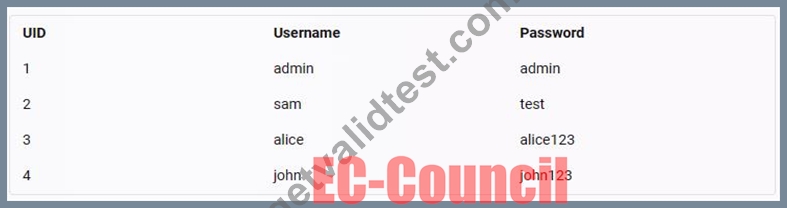
The UID that is mapped to user john is 4.
NEW QUESTION # 26
In an organization, all the servers and database systems are guarded in a sealed room with a single entry point. The entrance is protected with a physical lock system that requires typing a sequence of numbers and letters by using a rotating dial that intermingles with several other rotating discs.
Which of the following types of physical locks is used by the organization in the above scenario?
- A. Mechanical locks
- B. Digital locks
- C. Combination locks
- D. Electromagnetic locks
Answer: C
NEW QUESTION # 27
Kason, a forensic officer, was appointed to investigate a case where a threat actor has bullied certain children online. Before proceeding legally with the case, Kason has documented all the supporting documents, including source of the evidence and its relevance to the case, before presenting it in front of the jury.
Which of the following rules of evidence was discussed in the above scenario?
- A. Reliable
- B. Admissible
- C. Authentic
- D. Understandable
Answer: B
Explanation:
Admissible is the rule of evidence discussed in the above scenario. A rule of evidence is a criterion or principle that determines whether a piece of evidence can be used in a legal proceeding or investigation. Admissible is a rule of evidence that states that the evidence must be relevant, reliable, authentic, and understandable to be accepted by a court or a jury . Admissible also means that the evidence must be obtained legally and ethically, without violating any laws or rights. In the scenario, Kason has documented all the supporting documents, including source of the evidence and its relevance to the case, before presenting it in front of the jury, which means that he has followed the admissible rule of evidence. Authentic is a rule of evidence that states that the evidence must be original or verifiable as genuine and not altered or tampered with. Understandable is a rule of evidence that states that the evidence must be clear and comprehensible to the court or jury and not ambiguous or confusing. Reliable is a rule of evidence that states that the evidence must be consistent and trustworthy and not based on hearsay or speculation.
NEW QUESTION # 28
You work in a Multinational Company named Vector Inc. on Hypervisors and Virtualization Software. You are using the Operating System (OS) Virtualization and you have to handle the Security risks associated with the OS virtualization. How can you mitigate these security risks?
- A. Implement least privilege access control for users managing VMs.
- B. Disable security features on virtual machines to improve performance.
- C. Regularly patch and update the hypervisor software for security fixes.
- D. All of the above
Answer: D
Explanation:
Mitigating security risks associated with OS virtualization involves a comprehensive approach. Here's a breakdown of the steps:
* Implement Least Privilege Access Control for Users Managing VMs:
* Limit access to only those users who need it.
* Ensure that users have only the permissions necessary to perform their tasks.
* Regularly Patch and Update the Hypervisor Software for Security Fixes:
* Keep the hypervisor and virtualization software up-to-date to protect against known vulnerabilities.
* Regular patching minimizes the risk of exploitation.
* Disable Security Features on Virtual Machines to Improve Performance:
* Note: This is actually a security risk. The correct approach is toenable and configure security featuresto protect VMs, despite the potential minor impact on performance.
Comprehensive Approach:
* A holistic security strategy includes enforcing least privilege, maintaining updated systems, and enabling security features on VMs to protect against a wide range of threats.
References:
* EC-Council Certified Ethical Hacker (CEH) materials.
* Best practices for virtualization security from NIST and other cybersecurity frameworks.
NEW QUESTION # 29
Nancy, a security specialist, was instructed to identify issues related to unexpected shutdown and restarts on a Linux machine. To identify the incident cause, Nancy navigated to a directory on the Linux system and accessed a log file to troubleshoot problems related to improper shutdowns and unplanned restarts.
Identify the Linux log file accessed by Nancy in the above scenario.
- A. /var/log/lighttpd/
- B. /var/log/kern.log
- C. /var/log/secure
- D. /var/log/boot.log
Answer: D
Explanation:
/var/log/boot.log is the Linux log file accessed by Nancy in the above scenario. Linux is an open-source operating system that logs various events and activities on the system or network. Linux log files are stored in the /var/log directory, which contains different types of log files for different purposes. /var/log/boot.log is the type of log file that records events related to the booting process of the Linux system, such as loading drivers, services, modules, etc. /var/log/boot.log can help identify issues related to unexpected shutdowns and restarts on a Linux machine . /var/log/secure is the type of log file that records events related to security and authentication, such as logins, logouts, password changes, sudo commands, etc. /var/log/kern.log is the type of log file that records events related to the kernel, such as kernel messages, errors, warnings, etc.
/var/log/lighttpd/ is the directory that contains log files related to the lighttpd web server, such as access logs, error logs, etc.
NEW QUESTION # 30
You have been assigned to perform a vulnerability assessment of a web server located at IP address 20.20.10.26. Identify the vulnerability with a severity score of &A. You can use the OpenVAS vulnerability scanner, available with the Parrot Security machine, with credentials admin/password for this challenge.
- A. FTP Unencrypted Cleartext Login
- B. TCP limestamps
- C. Anonymous FTP Login Reporting
- D. UDP limestamps
Answer: B
Explanation:
TCP Timestamps is the vulnerability with a severity score of 8.0. This can be verified by performing a vulnerability assessment of the web server located at IP address 20.20.10.26 using the OpenVAS vulnerability scanner, available with the Parrot Security machine, with credentials admin/password. To perform the vulnerability assessment, one can follow these steps:
Launch the Parrot Security machine and open a terminal. Enter the command sudo openvas-start to start the OpenVAS service and wait for a few minutes until it is ready.
Open a web browser and navigate to https://127.0.0.1:9392 to access the OpenVAS web interface. Enter the credentials admin/password to log in to OpenVAS. Click on Scans -> Tasks from the left menu and then click on the blue icon with a star to create a new task.
Enter a name and a comment for the task, such as "Web Server Scan". Select "Full and fast" as the scan config from the drop-down menu. Click on the icon with a star next to Target to create a new target. Enter a name and a comment for the target, such as "Web Server". Enter 20.20.10.26 as the host in the text box and click on Save. Select "Web Server" as the target from the drop- down menu and click on Save. Click on the green icon with a play button next to the task name to start the scan and wait for it to finish.
Click on the task name to view the scan report and click on Results from the left menu to see the list of vulnerabilities found.
Sort the list by Severity in descending order and look for the vulnerability with a severity score of
8.0. The screenshot below shows an example of performing these steps: The vulnerability with a severity score of 8.0 is TCP Timestamps, which is an option in TCP packets that can be used to measure round-trip time and improve performance, but it can also reveal information about the system's uptime, clock skew, or TCP sequence numbers, which can be used by attackers to launch various attacks, such as idle scanning, OS fingerprinting, or TCP hijacking. The vulnerability report provides more details about this vulnerability, such as its description, impact, solution, references, and CVSS score.
NEW QUESTION # 31
You are the chief cybersecurity officer at a multi-national corporation, which specializes in satellite- based communication systems. Recently, you transitioned to a more advanced system architecture that includes multiple ground stations globally. These stations synchronize and communicate via a central hub that manages the distribution of encrypted data across the network. Upon reviewing the quarterly network logs, you uncover a series of sophisticated intrusions. These intrusions are intermittently taking place inground stations located in three continents. Evidence suggests that these attacks are coordinated, aiming to map out the network's communication paths, likely in preparation for a much larger scale cyber-attack. Further investigation uncovers small pockets of malware within the system, specifically designed to circumvent your current security controls. Given the criticality of ensuring uninterrupted satellite communication, which countermeasure would be most effective in thwarting these intrusions, ensuring data integrity, and maintaining the operational status of your satellite communication systems?
- A. Implement air-gapped systems for each ground station to ensure complete isolation, minimizing the risk of malware spread and external intrusions.
- B. Enhance end-point security solutions at each ground station, focusing on advanced malware detection, eradication, and prevention.
- C. Deploy an advanced network segmentation strategy, ensuring each ground station operates in a micro-segmented environment, with real-time threat monitoring and dynamic policy adjustments.
- D. Rollback the system to its previous architecture, while launching a thorough investigation into the identified intrusions and taking the necessary legal actions.
Answer: C
NEW QUESTION # 32
In a multinational corporation, the IT department Implemented a new network security protocol for their global data centers. This protocol was designed to enhance security measures by incorporating advanced access control principles. The protocol employs a combination of methods to ensure that only authorized personnel can access sensitive data. Recently, an incident occurred where an unauthorized user gained access to confidential data. The security team discovered that the intruder exploited a specific aspect of the access control system.
Which aspect of the access control principles, terminologies, and models was most likely exploited?
- A. Discretionary Access Control (DAC). where the resource owner decides on the access permissions.
- B. Role-Based Access Control (RBAC). where access is given based on the roles within the organization.
- C. Attribute-Based Access Control {ABAC), where access decisions are made based on a set of policies and attributes.
- D. Mandatory Access Control (MAC), where access decisions are made based on predefined rules set by the system s administrator.
Answer: A
NEW QUESTION # 33
A threat intelligence feed data file has been acquired and stored in the Documents folder of Attacker Machine-1 (File Name: Threatfeed.txt). You are a cybersecurity technician working for an ABC organization. Your organization has assigned you a task to analyze the data and submit a report on the threat landscape. Select the IP address linked with http://securityabc.s21sec.com.
- A. 5.9.110.120
- B. 5.9.200.150
- C. 5.9.188.148
- D. 5.9.200.200
Answer: C
NEW QUESTION # 34
In an advancedcybersecurity research lab. a team Is working on developing a new cryptographicprotocol to secure highly sensitive communication. Their goal is to create aprotocol that is resilient against quantum computing attacks, which couldpotentially break many current encryption methods. During their research, theyfocus on the use of hash functions in their protocol. The team experiments withvarious hash functions to ensure the highest level of security. Considering thethreat of quantum computing, which of the following hash functions would be themost appropriate choice fortheir protocol?
- A. HMAC. for its ability to provide data integrity and authentication
- B. SHA-3. as it is designed to be resistant against quantum computing attacks
- C. SHA-256, due to its widespread use and proven security track record
- D. MD5, for its speed and efficiency in generating hash values
Answer: B
Explanation:
In the context of developing a cryptographic protocol resilient against quantum computing attacks, SHA-3 is the most appropriate choice. Here's why:
* Quantum Computing Threats: Quantum computers can potentially break current cryptographic methods like RSA and ECC due to Shor's algorithm. Traditional hash functions like SHA-256 might not offer sufficient security in a post-quantum world.
* SHA-3 Overview: SHA-3, part of the Secure Hash Algorithm family, was designed with quantum resistance in mind. It was selected through an open competition by NIST, ensuring it incorporates advanced cryptographic techniques.
* Resilience: SHA-3's design is fundamentally different from SHA-2, providing enhanced security properties, including resistance to various attack vectors that might be feasible with quantum computing advancements.
References:
* NIST SHA-3 Standard:NIST FIPS PUB 202
* Research on quantum-resistant cryptography:IEEE Xplore
NEW QUESTION # 35
A large multinational corporation is In the process of upgrading its network infrastructure to enhance security and protect sensitive data. As part of the upgrade, the IT team is considering implementing stateful multilayer inspection firewalls and application-level gateway firewalls.
How do stateful multilayer inspection firewalls differ from application-level gateway firewalls in terms of their packet filtering capabilities and the layers of the OSI model they inspect?
- A. Stateful multilayer inspection firewalls filter traffic based on specified application rules, applications, or protocols, while application-level gateway firewalls allow unknown traffic up to level
2 of the network stack. - B. Stateful multilayer inspection firewalls track and maintain session information between hosts, while application-level gateway firewalls control input, output, and access across applications or services.
- C. Stateful multilayer inspection firewalls are more expensive and require competent personnel to administer them, while application-level gateway firewalls evaluate network packets for valid data at the application layer.
- D. Stateful multilayer inspection firewalls focus on inspecting packets at the application layer, while application-level gateway firewalls primarily filter packets at the network layer.
Answer: B
NEW QUESTION # 36
Tristan, a professional penetration tester, was recruited by an organization to test its network infrastructure. The organization wanted to understand its current security posture and its strength in defending against external threats. For this purpose, the organization did not provide any information about their IT infrastructure to Tristan. Thus, Tristan initiated zero-knowledge attacks, with no information or assistance from the organization.
Which of the following types of penetration testing has Tristan initiated in the above scenario?
- A. White-box testing
- B. Gray-box testing
- C. Translucent-box testing
- D. Black-box testing
Answer: D
NEW QUESTION # 37
You've been called in as a computer forensics investigator to handle a case involving a missing company laptop from the accounting department, which contained sensitive financial data. The company suspects a potential data breach and wants to recover any evidence from the missing device. What is your MOST important initial action regarding the digital evidence?
- A. Turn on the laptop (if found) and search for deleted files.
- B. Report the incident to law enforcement immediately.
- C. Interview company personnel to understand the missing laptop's usage.
- D. Secure the scene where the laptop was last seen (if possible).
Answer: D
NEW QUESTION # 38
Stella purchased a smartwatch online using her debit card. After making payment for the product through the payment gateway, she received a transaction text message with a deducted and available balance from her bank.
Identify the information security element that ensures that Stella's transaction status is immediately reflected in her bank account in this scenario.
- A. Availability
- B. Integrity
- C. Non-repudiation
- D. Confidentiality
Answer: A
Explanation:
Availability is the information security element that ensures that Stella's transaction status is immediately reflected in her bank account in this scenario. Information security is the practice of protecting information and information systems from unauthorized access, use, disclosure, modification, or destruction. Information security can be based on three fundamental principles: confidentiality, integrity, and availability. Confidentiality is the principle that ensures that information is accessible only to authorized parties and not disclosed to unauthorized parties. Integrity is the principle that ensures that information is accurate, complete, and consistent and not altered or corrupted by unauthorized parties. Availability is the principle that ensures that information and information systems are accessible and usable by authorized parties when needed. In the scenario, Stella purchased a smartwatch online using her debit card. After making payment for the product through the payment gateway, she received a transaction text message with a deducted and available balance from her bank. This means that her transaction status was immediately reflected in her bank account, which indicates that availability was ensured by her bank's information system.
NEW QUESTION # 39
An MNC hired Brandon, a network defender, to establish secured VPN communication between the company's remote offices. For this purpose, Brandon employed a VPN topology where all the remote offices communicate with the corporate office but communication between the remote offices is denied.
Identify the VPN topology employed by Brandon in the above scenario.
- A. Full-mesh VPN topology
- B. Hub-and-Spoke VPN topology
- C. Point-to-Point VPN topology
- D. Star topology
Answer: B
NEW QUESTION # 40
......
212-82 certification guide Q&A from Training Expert GetValidTest: https://troytec.getvalidtest.com/212-82-brain-dumps.html