


AZ-304 PDF Dumps Dec 09, 2024 Exam Questions – Valid AZ-304 Dumps
Ultimate AZ-304 Guide to Prepare Free Latest Microsoft Practice Tests Dumps
Microsoft AZ-304, also known as the Microsoft Azure Architect Design Exam, is a certification exam that is designed for Azure Solution Architects who have an in-depth knowledge of Azure services and are responsible for managing the entire implementation lifecycle. Microsoft Azure Architect Design certification exam is designed to validate the skills and knowledge of the Azure Solution Architect in designing and monitoring solutions, implementing solutions, and ensuring compliance and security best practices.
NEW QUESTION # 136
You need to recommend a solution for implementing the back-end tier of the payment processing system in Azure.
What should you include in the recommendation?
- A. an Azure SQL Database single database
- B. a SQL Server database on an Azure virtual machine
- C. an Azure SQL Database elastic pool
- D. an Azure SQL Database managed instance
Answer: A
Explanation:
Topic 2, Fabrikam, Inc
Existing Environment
Fabrikam, Inc. is an engineering company that has offices throughout Europe. The company has a main office in London and three branch offices in Amsterdam Berlin, and Rome.
Active Directory Environment:
The network contains two Active Directory forests named corp.fabnkam.com and rd.fabrikam.com. There are no trust relationships between the forests. Corp.fabrikam.com is a production forest that contains identities used for internal user and computer authentication. Rd.fabrikam.com is used by the research and development (R&D) department only.
Network Infrastructure:
Each office contains at least one domain controller from the corp.fabrikam.com domain. The main office contains all the domain controllers for the rd.fabrikam.com forest.
All the offices have a high-speed connection to the Internet.
An existing application named WebApp1 is hosted in the data center of the London office. WebApp1 is used by customers to place and track orders. WebApp1 has a web tier that uses Microsoft Internet Information Services (IIS) and a database tier that runs Microsoft SQL Server 2016. The web tier and the database tier are deployed to virtual machines that run on Hyper-V.
The IT department currently uses a separate Hyper-V environment to test updates to WebApp1.
Fabrikam purchases all Microsoft licenses through a Microsoft Enterprise Agreement that includes Software Assurance.
Problem Statement:
The use of Web App1 is unpredictable. At peak times, users often report delays. Al other times, many resources for WebApp1 are underutilized.
Requirements:
Planned Changes:
Fabrikam plans to move most of its production workloads to Azure during the next few years.
As one of its first projects, the company plans to establish a hybrid identity model, facilitating an upcoming Microsoft Office 365 deployment All R&D operations will remain on-premises.
Fabrikam plans to migrate the production and test instances of WebApp1 to Azure.
Technical Requirements:
Fabrikam identifies the following technical requirements:
* Web site content must be easily updated from a single point.
* User input must be minimized when provisioning new app instances.
* Whenever possible, existing on premises licenses must be used to reduce cost.
* Users must always authenticate by using their corp.fabrikam.com UPN identity.
* Any new deployments to Azure must be redundant in case an Azure region fails.
* Whenever possible, solutions must be deployed to Azure by using platform as a service (PaaS).
* An email distribution group named IT Support must be notified of any issues relating to the directory synchronization services.
* Directory synchronization between Azure Active Directory (Azure AD) and corp.fabhkam.com must not be affected by a link failure between Azure and the on premises network.
Database Requirements:
Fabrikam identifies the following database requirements:
* Database metrics for the production instance of WebApp1 must be available for analysis so that database administrators can optimize the performance settings.
* To avoid disrupting customer access, database downtime must be minimized when databases are migrated.
* Database backups must be retained for a minimum of seven years to meet compliance requirement Security Requirements:
Fabrikam identifies the following security requirements:
*Company information including policies, templates, and data must be inaccessible to anyone outside the company
*Users on the on-premises network must be able to authenticate to corp.fabrikam.com if an Internet link fails. *Administrators must be able authenticate to the Azure portal by using their corp.fabrikam.com credentials.
*All administrative access to the Azure portal must be secured by using multi-factor authentication.
*The testing of WebApp1 updates must not be visible to anyone outside the company.
NEW QUESTION # 137
You have the Free edition of a hybrid Azure Active Directory (Azure AD) tenant. The tenant uses password hash synchronization.
You need to recommend a solution to meet the following requirements:
Prevent Active Directory domain user accounts from being locked out as the result of brute force attacks targeting Azure AD user accounts.
Block legacy authentication attempts to Azure AD integrated apps.
Minimize costs.
What should you recommend for each requirement? To answer, select the appropriate options in the answer area.
NOTE: Each correct selection is worth one point.
Answer:
Explanation:
Reference:
https://docs.microsoft.com/en-us/azure/active-directory/authentication/howto-password-smart-lockout
https://docs.microsoft.com/en-us/azure/active-directory/conditional-access/block-legacy-authentication
NEW QUESTION # 138
Your company deploys several Linux and Windows virtual machines (VMs) to Azure. The VMs are deployed with the Microsoft Dependency Agent and the Log Analytics Agent installed by using Azure VM extensions. On-premises connectivity has been enabled by using Azure ExpressRoute.
You need to design a solution to monitor the VMs.
Which Azure monitoring services should you use? To answer, select the appropriate Azure monitoring services in the answer area.
NOTE: Each correct selection is worth one point.
Answer:
Explanation:
References:
https://docs.microsoft.com/en-us/azure/network-watcher/traffic-analytics
https://docs.microsoft.com/en-us/azure/azure-monitor/insights/service-map
NEW QUESTION # 139
You plan to import data from your on-premises environment into Azure. The data is shown in the following table.
What should you recommend using to migrate the data? To answer, drag the appropriate tools to the correct data sources. Each tool may be used once, more than once, or not at all. You may need to drag the split bar between panes or scroll to view content.
NOTE: Each correct selection is worth one point.
Answer:
Explanation:
Explanation
References:
https://docs.microsoft.com/en-us/azure/dms/tutorial-sql-server-to-azure-sql
https://docs.microsoft.com/en-us/azure/cosmos-db/import-data
NEW QUESTION # 140
You have an Azure App Service Web App that includes Azure Blob storage and an Azure SQL Database instance. The application is instrumented by using the Application Insights SDK.
You need to design a monitoring solution for the web app.
Which Azure monitoring services should you use? To answer, select the appropriate Azure monitoring services in the answer area.
NOTE: Each correct selection is worth one point.
Answer:
Explanation:
Explanation:
https://docs.microsoft.com/en-us/azure/azure-monitor/app/app-map?tabs=net
https://docs.microsoft.com/en-us/azure/azure-monitor/insights/service-map
NEW QUESTION # 141
You plan to deploy an Azure web app named Appl that will use Azure Active Directory (Azure AD) authentication.
App1 will be accessed from the internet by the users at your company. All the users have computers that run Windows 10 and are joined to Azure AD.
You need to recommend a solution to ensure that the users can connect to App1 without being prompted for authentication and can access App1 only from company-owned computers.
What should you recommend for each requirement? To answer, select the appropriate options in the answer area.
NOTE: Each correct selection is worth one point.
Answer:
Explanation:
Reference:
https://codingcanvas.com/using-azure-active-directory-authentication-in-your-web-application/
https://docs.microsoft.com/en-us/azure/active-directory/conditional-access/overview
NEW QUESTION # 142
Note: This question is part of a series of questions that present the same scenario. Each question in the series contains a unique solution that might meet the stated goals. Some question sets might have more than one correct solution, while others might not have a correct solution.
After you answer a question in this section, you will NOT be able to return to it. As a result, these questions will not appear in the review screen.
You have an Azure Storage v2 account named storage1.
You plan to archive data to storage1.
You need to ensure that the archived data cannot be deleted for five years. The solution must prevent administrators from deleting the data.
Solution: You create a file share, and you configure an access policy.
Does this meet the goal?
- A. Yes
- B. No
Answer: B
Explanation:
Instead of a file share, an immutable Blob storage is required.
Time-based retention policy support: Users can set policies to store data for a specified interval. When a time-based retention policy is set, blobs can be created and read, but not modified or deleted. After the retention period has expired, blobs can be deleted but not overwritten.
Note: Set retention policies and legal holds
1. Create a new container or select an existing container to store the blobs that need to be kept in the immutable state. The container must be in a general-purpose v2 or Blob storage account.
2. Select Access policy in the container settings. Then select Add policy under Immutable blob storage.
3. To enable time-based retention, select Time-based retention from the drop-down menu.
4. Enter the retention interval in days (acceptable values are 1 to 146000 days).
Reference:
https://docs.microsoft.com/en-us/azure/storage/blobs/storage-blob-immutable-storage
https://docs.microsoft.com/en-us/azure/storage/blobs/storage-blob-immutability-policies-manage Design Business Continuity Testlet 2 Case Study This is a case study. Case studies are not timed separately. You can use as much exam time as you would like to complete each case. However, there may be additional case studies and sections on this exam. You must manage your time to ensure that you are able to complete all questions included on this exam in the time provided.
To answer the questions included in a case study, you will need to reference information that is provided in the case study. Case studies might contain exhibits and other resources that provide more information about the scenario that is described in the case study. Each question is independent of the other questions in this case study.
At the end of this case study, a review screen will appear. This screen allows you to review your answers and to make changes before you move to the next section of the exam. After you begin a new section, you cannot return to this section.
To start the case study
To display the first question in this case study, click the Next button. Use the buttons in the left pane to explore the content of the case study before you answer the questions. Clicking these buttons displays information such as business requirements, existing environment, and problem statements. If the case study has an All Information tab, note that the information displayed is identical to the information displayed on the subsequent tabs. When you are ready to answer a question, click the Question button to return to the question.
Overview
Contoso, Ltd, is a US-based financial services company that has a main office in New York and a branch office in San Francisco.
Existing Environment. Payment Processing System
Contoso hosts a business-critical payment processing system in its New York data center. The system has three tiers: a front-end web app, a middle-tier web API, and a back-end data store implemented as a Microsoft SQL Server 2014 database. All servers run Windows Server 2012 R2.
The front-end and middle-tier components are hosted by using Microsoft Internet Information Services (IIS). The application code is written in C# and ASP.NET. The middle-tier API uses the Entity Framework to communicate to the SQL Server database. Maintenance of the database is performed by using SQL Server Agent jobs.
The database is currently 2 TB and is not expected to grow beyond 3 TB.
The payment processing system has the following compliance-related requirements:
* Encrypt data in transit and at rest. Only the front-end and middle-tier components must be able to access the encryption keys that protect the data store.
* Keep backups of the data in two separate physical locations that are at least 200 miles apart and can be restored for up to seven years.
* Support blocking inbound and outbound traffic based on the source IP address, the destination IP address, and the port number.
* Collect Windows security logs from all the middle-tier servers and retain the logs for a period of seven years.
* Inspect inbound and outbound traffic from the front-end tier by using highly available network appliances.
* Only allow all access to all the tiers from the internal network of Contoso.
Tape backups are configured by using an on-premises deployment of Microsoft System Center Data Protection Manager (DPM), and then shipped offsite for long term storage.
Existing Environment. Historical Transaction Query System
Contoso recently migrated a business-critical workload to Azure. The workload contains a .NET web service for querying the historical transaction data residing in Azure Table Storage. The .NET web service is accessible from a client app that was developed in-house and runs on the client computers in the New York office. The data in the table storage is 50 GB and is not expected to increase.
Existing Environment. Current Issues
The Contoso IT team discovers poor performance of the historical transaction query system, as the queries frequently cause table scans.
Requirements. Planned Changes
Contoso plans to implement the following changes:
* Migrate the payment processing system to Azure.
* Migrate the historical transaction data to Azure Cosmos DB to address the performance issues.
Requirements. Migration Requirements
Contoso identifies the following general migration requirements:
* Infrastructure services must remain available if a region or a data center fails. Failover must occur without any administrative intervention.
* Whenever possible, Azure managed services must be used to minimize management overhead.
* Whenever possible, costs must be minimized.
Contoso identifies the following requirements for the payment processing system:
* If a data center fails, ensure that the payment processing system remains available without any administrative intervention. The middle-tier and the web front end must continue to operate without any additional configurations.
* Ensure that the number of compute nodes of the front-end and the middle tiers of the payment processing system can increase or decrease automatically based on CPU utilization.
* Ensure that each tier of the payment processing system is subject to a Service Level Agreement (SLA) of 99.99 percent availability.
* Minimize the effort required to modify the middle-tier API and the back-end tier of the payment processing system.
* Payment processing system must be able to use grouping and joining tables on encrypted columns.
* Generate alerts when unauthorized login attempts occur on the middle-tier virtual machines.
* Ensure that the payment processing system preserves its current compliance status.
* Host the middle tier of the payment processing system on a virtual machine Contoso identifies the following requirements for the historical transaction query system:
* Minimize the use of on-premises infrastructure services.
* Minimize the effort required to modify the .NET web service querying Azure Cosmos DB.
* Minimize the frequency of table scans.
* If a region fails, ensure that the historical transaction query system remains available without any administrative intervention.
Requirements. Information Security Requirements
The IT security team wants to ensure that identity management is performed by using Active Directory.
Password hashes must be stored on-premises only.
Access to all business-critical systems must rely on Active Directory credentials. Any suspicious authentication attempts must trigger a multi-factor authentication prompt automatically.
NEW QUESTION # 143
You plan to deploy the backup policy shown in the following exhibit.
Use the drop-down menus to select the answer choice that completes each statement based on the information presented in the graphic.
NOTE: Each correct selection is worth one point.
Answer:
Explanation: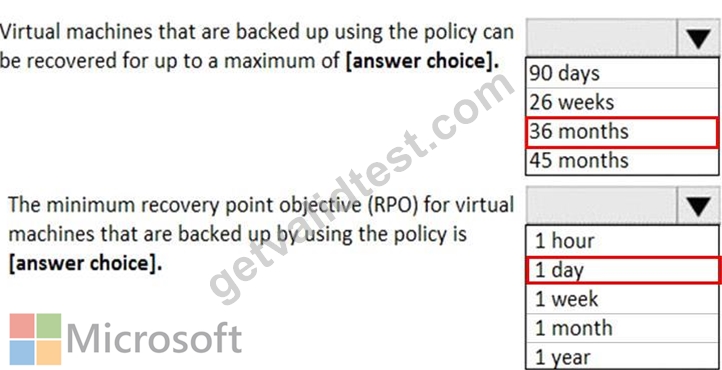
NEW QUESTION # 144
You plan to create an Azure environment that will have a root management group and five child and five child management groups. Each child management group will contains five Azure subscriptions. You plan to have between 10 and 30 resource group in each subscription.
Ensure that you can update RBAC role assignment all the subscription and resource groups.
Minimize administrative effort.
What should you include in the solution? To answer, select the appropriate options in the answer area.
NOTE: Each correct selection is worth one point.
Answer:
Explanation:
NEW QUESTION # 145
HOTSPOT
You have an Azure subscription that contains the SQL servers on Azure shown in the following table.
The subscription contains the storage accounts shown in the following table.
You create the Azure SQL databases shown in the following table.
For each of the following statements, select Yes if the statement is true. Otherwise, select No.
NOTE: Each correct selection is worth one point.
Hot Area:
Answer:
Explanation:
Explanation:
Box 1: Yes
Be sure that the destination is in the same region as your database and server.
Box 2: No
Box 3: No
Reference:
https://docs.microsoft.com/en-us/azure/sql-database/sql-database-auditing
NEW QUESTION # 146
Your company plans to publish APIs for its services by using Azure API Management.
You discover that service responses include the AspNet-Version header.
You need to recommend a solution to remove AspNet-Version from the response of the published APIs.
What should you include in the recommendation?
- A. a new policy
- B. a new product
- C. a modification to the URL scheme
Answer: A
Explanation:
Set a new transformation policy to transform an API to strip response headers.
Reference:
https://docs.microsoft.com/en-us/azure/api-management/transform-api
NEW QUESTION # 147
You have an Azure Storage v2 account named storage1.
You plan to archive data to storage1.
You need to ensure that the archived data cannot be deleted for five years. The solution must prevent administrators from deleting the data.
What should you do?
- A. You create a file share and snapshots.
- B. You create a file share, and you configure an access policy.
- C. You create an Azure Blob storage container, and you configure a time-based retention policy and lock the policy.
- D. You create an Azure Blob storage container, and you configure a legal hold access policy.
Answer: C
Explanation:
Explanation
https://docs.microsoft.com/en-us/azure/storage/blobs/storage-blob-immutability-policies-manage?tabs=azure-po
NEW QUESTION # 148
You need to recommend a solution for the user at Contoso to authenticate to the cloud-based sconces and the Azure AD-integrated application. What should you include in the recommendation? To answer, select the appropriate options in the answer area.
NOTE: Each correct selection is worth one point.
Answer:
Explanation: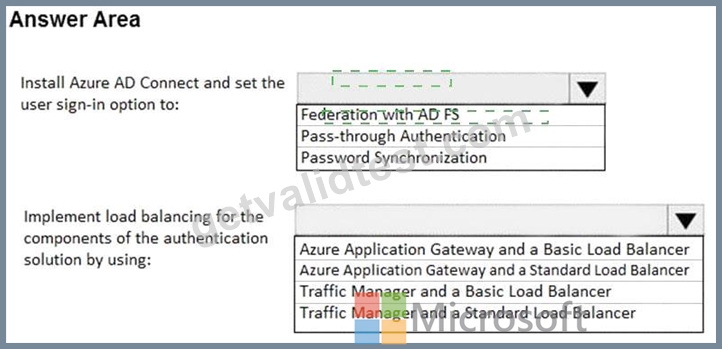
Explanation
NEW QUESTION # 149
You have an Azure subscription that contains 100 virtual machines.
You plan to design a data protection strategy to encrypt the virtual disks.
You need to recommend a solution to encrypt the disks by using Azure Disk Encryption. The solution must provide the ability to encrypt operating system disks and data disks.
What should you include in the recommendation?
- A. a certificate
- B. a passphrase
- C. a secret
- D. a key
Answer: D
Explanation:
For enhanced virtual machine (VM) security and compliance, virtual disks in Azure can be encrypted. Disks are encrypted by using cryptographic keys that are secured in an Azure Key Vault. You control these cryptographic keys and can audit their use.
Reference:
https://docs.microsoft.com/en-us/azure/virtual-machines/windows/encrypt-disks
NEW QUESTION # 150
You have an Azure subscription that contains 300 Azure virtual machines that run Windows Server 2016.
You need to centrally monitor all warning events in the System logs of the virtual machines.
What should you include in the solutions? To answer, select the appropriate options in the answer area.
NOTE: Each correct selection is worth one point.
Answer:
Explanation:
Explanation
References:
https://docs.microsoft.com/en-us/azure/azure-monitor/platform/data-sources-windows-events
https://docs.microsoft.com/en-us/azure/azure-monitor/platform/agent-windows
NEW QUESTION # 151
You have an Azure blueprint named BP1.
The properties of BP1 are shown in the Properties exhibit. (Click the tab.)
The basic configuration of the blueprint is shown in the Basics exhibit. (Click the Basics tab.)
The artifacts attached to BP1 are shown in the Artifacts exhibit. (Click the Artifacts tab.)
For each of the following statements, select Yes if the statement is true. Otherwise, select No.
NOTE: Each correct selection is worth one point.
Answer:
Explanation:
Explanation
Box 1: No
BP1 is in draft mode.
When a blueprint is first created, it's considered to be in Draft mode. When it's ready to be assigned, it needs to be Published.
Box 2: No
The BP1 artifacts include one Policy assignment and a Resource group, but no Role assignments.
Note: Blueprints are a declarative way to orchestrate the deployment of various resource templates and other artifacts such as:
Role Assignments
Policy Assignments
Azure Resource Manager templates (ARM templates)
Resource Groups
Box 3: Yes
Yes, the BP1 artifacts include a Resource group.
Reference:
https://docs.microsoft.com/en-us/azure/governance/blueprints/overview
NEW QUESTION # 152
......
Helpful Books to Ace AZ-304
Candidates can incorporate the following books from Amazon in their preparation process to ensure they pass exam AZ-304 with flying colors:
- ‘AZ-304: Microsoft Azure Architect Design 170+ Exam Practice Questions’ by Analytiq Tech. This book contains valid questions along with their detailed explanations and reference links. With this Kindle e-book, students will have access to comprehensive information on every single concept and mock question so they can learn from their mistakes. In total, the material contains 3 sets of practice exams, with at least 50 questions in each of them. These samples are meant to exactly simulate the real AZ-304 test, hence the time limits, passing scores, and question formats are exactly the same as the real one. The questions found in this e-book are all original and are scenario-based. Therefore, referring to this material will help candidates assess where they currently stand in terms of their exam preparation and advance accordingly. It also helps to become familiar with the patterns and formats of the real test, meaning they are likely to score higher. Also, new questions are added to this e-book on a regular basis and other questions are updated based on student input.
- ‘Microsoft Azure Architect Technologies and Design Complete Study Guide’ by Benjamin Perkins and William Panek. This book involves information about both AZ-303 and AZ-304 exams making one’s studies complete. This paperback has a 4-star rating on Amazon and thus will surely assist candidates to fully grasp Azure, learn how to configure MS cloud network, solve real-world IT issues, and get the confidence needed to pass the exam. The book also includes review questions, mock tests, and instructions on how to perform the tasks one will face in the job role of an Azure Solutions Architect.
The material will also grant learners access to the Sybex platform which means they will be able to incorporate various interactive learning tools such as flash cards, sample exercises, test banks, and searchable glossaries when they study. However, the book itself is also rich in real-world examples. And since it offers detailed & complete coverage of the topics needed for AZ-304, candidates will be able to learn fast and achieve a deep level of understanding. After completing this book, the students will be ready to start creating secure solutions using Microsoft Azure.
- ‘Exam Ref AZ-304 Microsoft Azure Architect Design 1st Edition’ by Ashish Agrawal, Avinash Bhavsar, MJ Parker, and Gurvinder Singh. This is the official book provided by Microsoft for AZ-304 exam. It addresses real-world skills that IT professionals will need when working with Azure cloud applications. The information in this paperback comes directly from the vendor and so is very reliable, and covers all the areas candidates have to understand to pass AZ-304 test. The content of the guide is organized in a very systematic way according to the official list of objectives. The material also includes ‘what if’ scenarios to help individuals apply what they learn in theory to diverse real-life situations.
Passing Key To Getting AZ-304 Certified Exam Engine PDF: https://troytec.getvalidtest.com/AZ-304-brain-dumps.html