


PCNSA Training & Certification Get Latest Paloalto Network Security Administrator Updated on Nov 26, 2024
Certification Training for PCNSA Exam Dumps Test Engine
The PCNSA certification is recognized globally and demonstrates the candidate's proficiency in using Palo Alto Networks products and services. Palo Alto Networks Certified Network Security Administrator certification is ideal for network security professionals who want to enhance their skills and knowledge in network security and demonstrate their expertise to their employers and peers. Palo Alto Networks Certified Network Security Administrator certification also provides a competitive advantage in the job market, as it is highly valued by organizations that use Palo Alto Networks products and services.
NEW QUESTION # 151
All users from the internal zone must be allowed only Telnet access to a server in the DMZ zone. Complete the two empty fields in the Security Policy rules that permits only this type of access.
Choose two.
- A. Service - "application-default"
- B. Application = "Telnet"
- C. Service = "any"
- D. Application = "any"
Answer: A,B
NEW QUESTION # 152
Arrange the correct order that the URL classifications are processed within the system.
Answer:
Explanation:
NEW QUESTION # 153
Which license must an administrator acquire prior to downloading Antivirus updates for use with the firewall?
- A. Antivirus
- B. URL filtering
- C. Threat Prevention
- D. WildFire
Answer: C
NEW QUESTION # 154
Based on the security policy rules shown, ssh will be allowed on which port?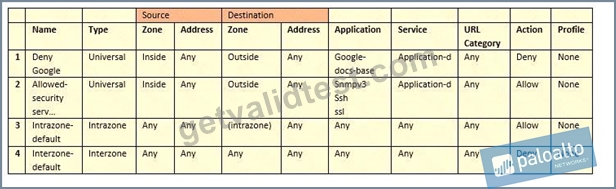
- A. any port
- B. only ephemeral ports
- C. the default port
- D. same port as ssl and snmpv3
Answer: C
NEW QUESTION # 155
Given the image, which two options are true about the Security policy rules. (Choose two.)
- A. In the Allow Social Networking rule, allows all of Facebook's functions
- B. The Allow Office Programs rule is using an Application Group
- C. In the Allow FTP to web server rule, FTP is allowed using App-ID
- D. The Allow Office Programs rule is using an Application Filter
Answer: A,D
Explanation:
In the Allow FTP to web server rule, FTP is allowed using port based rule and not APP-ID.
NEW QUESTION # 156
Based on the screenshot, what is the purpose of the Included Groups?
- A. They are the only groups visible based on the firewall's credentials.
- B. They contain only the users you allow to manage the firewall.
- C. They are used to map users to groups.
- D. They are groups that are imported from RADIUS authentication servers.
Answer: C
Explanation:
https://docs.paloaltonetworks.com/pan-os/9-1/pan-os-admin/user-id/map-users-to-groups.html
NEW QUESTION # 157
Which type of security rule will match traffic between the Inside zone and Outside zone, within the Inside zone, and within the Outside zone?
- A. global
- B. interzone
- C. universal
- D. intrazone
Answer: C
NEW QUESTION # 158
Recently changes were made to the firewall to optimize the policies and the security team wants to see if those changes are helping.
What is the quickest way to reset the hit counter to zero in all the security policy rules?
- A. Use the Reset Rule Hit Counter > All Rules option
- B. Reboot the firewall
- C. Highlight a rule and use the Reset Rule Hit Counter > Selected Rules for each rule
- D. At the CLI enter the command reset rules and press Enter
Answer: A
Explanation:
Explanation/Reference: https://docs.paloaltonetworks.com/pan-os/8-1/pan-os-web-interface-help/policies/policies-security/ creating-and-managing-policies
NEW QUESTION # 159
Which stage of the cyber-attack lifecycle makes it important to provide ongoing education to users on spear phishing links, unknown emails, and risky websites?
- A. installation
- B. exploitation
- C. delivery
- D. reconnaissance
Answer: C
Explanation:
Weaponization and Delivery: Attackers will then determine which methods to use in order to deliver malicious payloads. Some of the methods they might utilize are automated tools, such as exploit kits, spear phishing attacks with malicious links, or attachments and malvertizing.
Gain full visibility into all traffic, including SSL, and block high-risk applications. Extend those protections to remote and mobile devices.
Protect against perimeter breaches by blocking malicious or risky websites through URL filtering.
Block known exploits, malware and inbound command-and-control communications using multiple threat prevention disciplines, including IPS, anti-malware, anti-CnC, DNS monitoring and sinkholing, and file and content blocking.
Detect unknown malware and automatically deliver protections globally to thwart new attacks.
Provide ongoing education to users on spear phishing links, unknown emails, risky websites, etc.
https://www.paloaltonetworks.com/cyberpedia/how-to-break-the-cyber-attack-lifecycle
NEW QUESTION # 160
Given the image, which two options are true about the Security policy rules. (Choose two.)
- A. The Allow-Social-Media rule allows all of Facebook's functions.
- B. The Allow-Office-Programs rule is using an Application Group.
- C. The Allow-Office-Programs rule is using an Application Filter.
- D. In the Allow-FTP policy, FTP is allowed using App-ID.
Answer: A,C
Explanation:
Allow-Office-Program rule is indeed using Application Filter as seen on the Application Icon.
The Allow-Social-Media rule allows all Facebook's function as, the Facebook App ID is the Parent App-ID.
FTP is allowed using service not App-ID. The Allow-Office-Program rule is using an application filter not an Application Group.
NEW QUESTION # 161
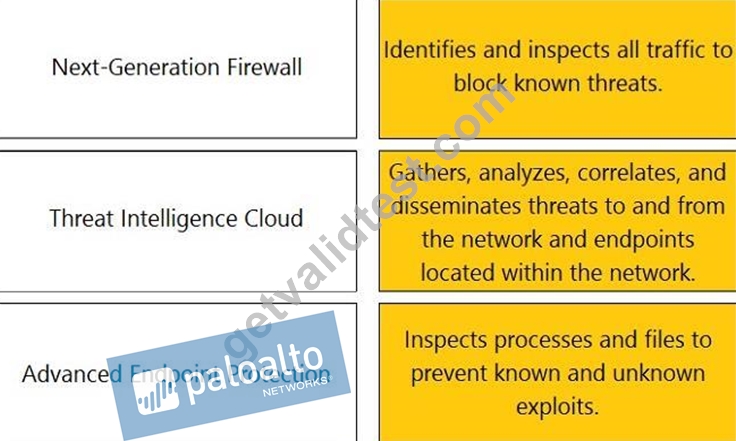
Match each feature to the DoS Protection Policy or the DoS Protection Profile.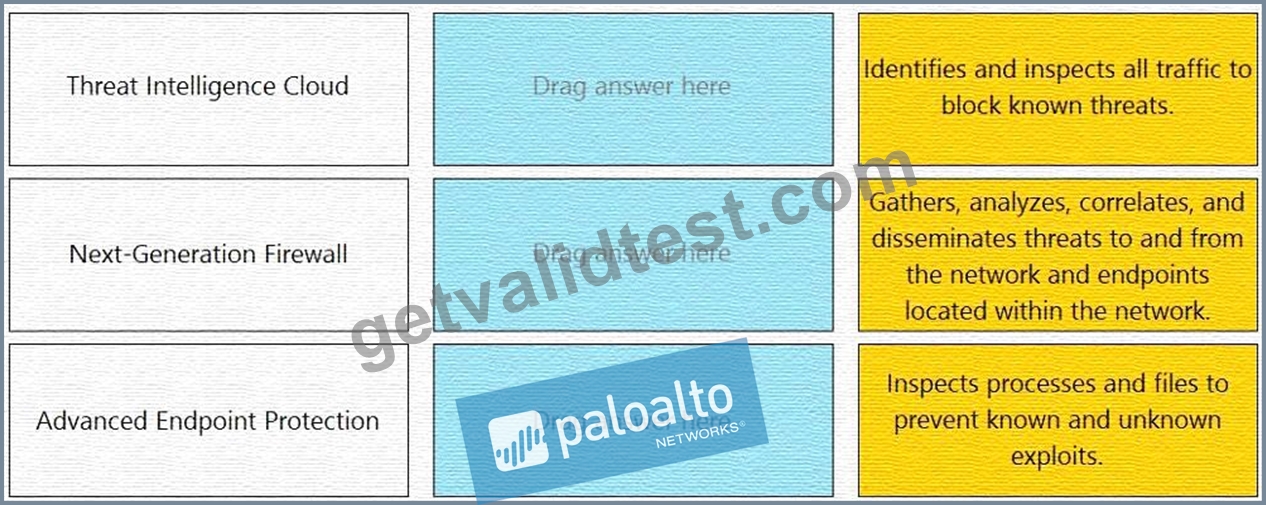
Answer:
Explanation: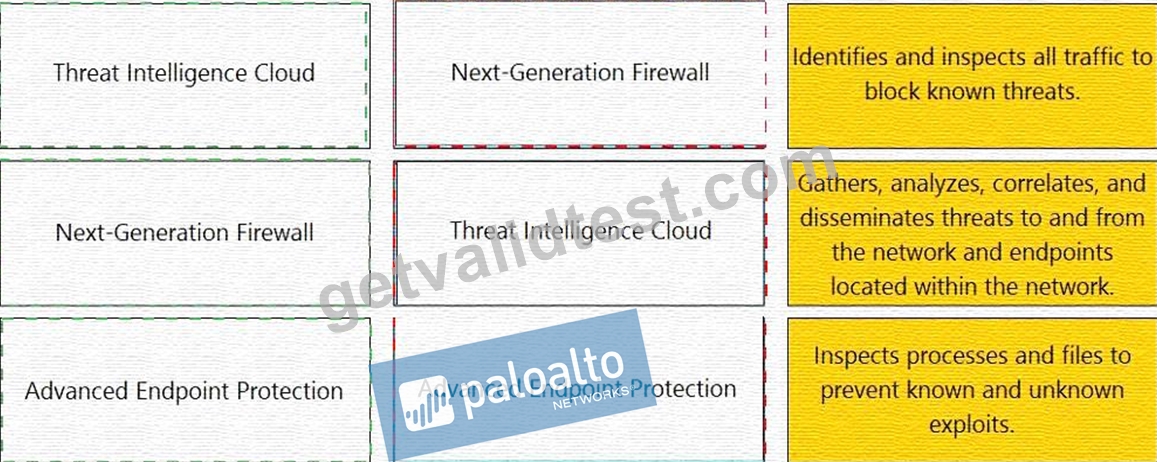
NEW QUESTION # 162
Prior to a maintenance-window activity, the administrator would like to make a backup of only the running configuration to an external location. What command in Device > Setup > Operations would provide the most operationally efficient way to achieve this outcome?
- A. save candidate config
- B. save named configuration snapshot
- C. export named configuration snapshot
- D. export device state
Answer: B
Explanation:
Export Named Configuration Snapshot This option exports the current running configuration, a candidate configuration snapshot, or a previously imported configuration (candidate or running). The firewall exports the configuration as an XML file with the specified name. You can save the snapshot in any network location. These exports often are used as backups. These XML files also can be used as templates for building other firewall configurations.
NEW QUESTION # 163
When creating an address object, which option is available to select from the Type drop-down menu?
- A. IPv4 Address
- B. IP Address Class
- C. IP Netmask
- D. IPv6 Address
Answer: C
NEW QUESTION # 164
An administrator is reviewing another administrator s Security policy log settings Which log setting configuration is consistent with best practices tor normal traffic?
- A. Log at Session Start enabled Log at Session End disabled
- B. Log at Session Start disabled Log at Session End enabled
- C. Log at Session Start and Log at Session End both enabled
- D. Log at Session Start and Log at Session End both disabled
Answer: B
NEW QUESTION # 165
Drag and Drop Question
Match the cyber-attack lifecycle stage to its correct description.
Select and Place:
Answer:
Explanation: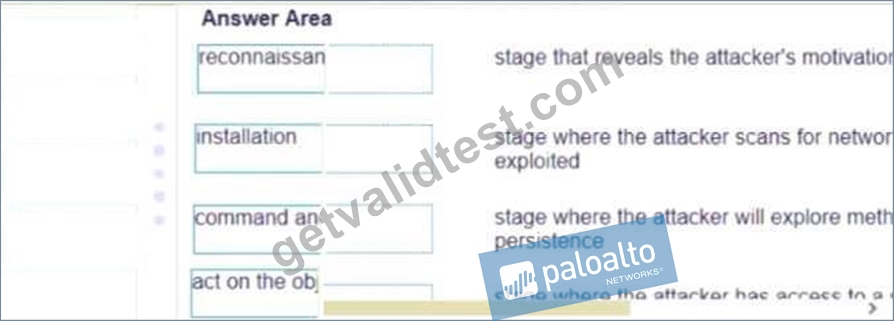
NEW QUESTION # 166
Which table for NAT and NPTv6 (IPv6-to-IPv6 Network Prefix Translation) settings is available only on Panorama?
- A. NAT Active/Active HA Binding Tab
- B. NAT Translated Packet Tab
- C. NAT Target Tab
- D. NAT Policies General Tab
Answer: C
Explanation:
The NAT Target tab is a table that allows you to specify the target firewalls or device groups for each NAT policy rule on Panorama. This tab is available only on Panorama and not on individual firewalls. The NAT Target tab enables you to create a single NAT policy rulebase on Panorama and then selectively push the rules to the firewalls or device groups that require them. This reduces the complexity and duplication of managing NAT policies across multiple firewalls1. Reference: NAT Target Tab, NAT Policy Overview, NPTv6 Overview, Updated Certifications for PAN-OS 10.1.
NEW QUESTION # 167
What is the default action for the SYN Flood option within the DoS Protection profile?
- A. Random Early Drop
- B. Alert
- C. Reset-client
- D. Sinkhole
Answer: A
Explanation:
DoS Protection Profiles and Policy Rules work together to provide protection against flooding of many incoming SYN, UDP, ICMP, and ICMPv6 packets, and other types of IP packets. You determine what thresholds constitute flooding. In general, the DoS Protection profile sets the thresholds at which the firewall generates a DoS alarm, takes action such as Random Early Drop, and drops additional incoming connections. A DoS Protection policy rule configured to protect (rather than to allow or deny packets) determines the criteria for packets to match (such as source address) in order to be counted toward the thresholds. This flexibility allows you to block certain traffic, or allow certain traffic and treat other traffic as DoS traffic. When the incoming rate exceeds your maximum threshold, the firewall blocks incoming traffic from the source address.
NEW QUESTION # 168
......
Exam Details
To obtain the PCNSA certification, the students are required to pass one qualifying exam. The test lasts for 80 minutes. An extra 10 minutes are allocated for reviewing Palo Alto Networks Exam Security Policy and Survey, so the total seat time of the exam is 90 minutes. The test is made up of 50 questions that are presented as scenarios with graphics, multiple-choice, and matching options. You can take the exam through Pearson VUE online or at one of the testing centers that are located in major cities of the world. The test is available in the English language only.
The PCNSA certification test costs $140. This amount is established for a single exam delivery. If you fail your test, you will have to pay another fee. You will also receive a score report highlighting the areas you need to pay more attention to. You will have to wait for five business days before you can retake the exam. If your second attempt is also unsuccessful, you will only be able to retake the test in 15 business days.
After successfully passing the qualifying test, you will be awarded the PCNSA certification. Your Palo Alto Networks certificate is valid for two years from the date of the exam completion. To maintain your certification status, you will be required to recertify by taking the most recent version of the test.
Step by Step Guide to Prepare for PCNSA Exam: https://troytec.getvalidtest.com/PCNSA-brain-dumps.html