


Updated PDF (New 2024) Actual ServiceNow CIS-Discovery Exam Questions
Verified CIS-Discovery Exam Dumps PDF [2024] Access using GetValidTest
NEW QUESTION # 66
SNMP Credentials require which of the following?
- A. port 135 access
- B. write community strings
- C. usernames
- D. read community strings
Answer: D
Explanation:
SNMP credentials are used by Discovery to communicate with devices that support the Simple Network Management Protocol (SNMP). SNMP credentials do not include a user name, just a password, called the community string. The default read-only community string for many SNMP devices is public, and Discovery will try that automatically. Enter the appropriate SNMP credentials if they differ from the public community string1.
References: 1: SNMP credentials - Product Documentation: Utah - Now Support Portal
NEW QUESTION # 67
When configuring the MID Server Service Settings, which of the following is not a valid MID Server name?
- A. mid.serverl
- B. midserverl
- C. mid serverl
- D. mymidserverl
Answer: C
Explanation:
In configuring the MID Server Service Settings in ServiceNow, the MID Server name must adhere to certain naming conventions. Among the options provided, "mid server1" (D) is not a valid MID Server name because it contains a space. MID Server names should not include spaces or special characters that are not typically used in naming conventions. Names like "mymidserver1," "mid.server1," and "midserver1" are more in line with the standard naming practices. References = ServiceNow MID Server documentation, specifically the sections detailing MID Server configuration and naming conventions.
NEW QUESTION # 68
What is found on the far-right section of the Pattern Designer for horizontal patterns? (Choose two.)
- A. CMDB Dashboard
- B. CI Attributes
- C. Temporary Variables
- D. Operations
Answer: C,D
Explanation:
The Pattern Designer is a graphical tool that allows users to create and edit horizontal discovery patterns. The Pattern Designer has three main sections: the left section shows the CI type and the pattern type, the middle section shows the pattern steps and the flow diagram, and the far-right section shows the details of the selected step or operation. The far-right section can display the following tabs, depending on the type of step or operation selected12:
* Operations: This tab shows the list of available operations that can be added to the pattern, such as Execute Command, Parse File, Set Parameter Value, etc. Operations are the basic building blocks of a pattern that perform specific actions on the target device or the MID Server.
* CI Attributes: This tab shows the list of attributes that can be set or updated for the CI type of the pattern, such as name, serial number, manufacturer, etc. CI attributes are used to populate the CI record in the CMDB with the information collected by the pattern.
* Temporary Variables: This tab shows the list of temporary variables that can be created or used by the pattern, such as $result, $output, $user_var, etc. Temporary variables are used to store and manipulate data within the pattern, such as the output of a command, the value of a parameter, or the result of a calculation.
* CMDB Dashboard: This tab shows the CMDB dashboard that displays the CI record and its related lists, such as relationships, identification rules, sensors, etc. The CMDB dashboard is used to preview and verify the outcome of the pattern on the CI record in the CMDB.
References:
* 1: ServiceNow Discovery Documentation, Pattern Designer section
* 2: ServiceNow Discovery Overview, page 11
NEW QUESTION # 69
Discovery home page provides a new tile to view the results of.
Response:
- A. file-base discovery
- B. Asset discovery
- C. credential-less discovery
- D. Cloud discovery
Answer: D
NEW QUESTION # 70
Discovery finds and maps dependencies for the following types of storage devices. (Choose three.)
- A. Multiple area network (MAN)
- B. Redundant Array of Independent Disks (RAID)
- C. Storage area network (SAN)
- D. Direct-attached storage (DAS)
- E. Network-attached storage (NAS)
Answer: C,D,E
NEW QUESTION # 71
One method for deleting specific CIs not discovered in 30 days is:
- A. Data Policy
- B. Scheduled Job
- C. UI Policy
- D. Service Mapping
Answer: B
Explanation:
One method for deleting specific CIs not discovered in 30 days is to use a scheduled job that runs a script to query the CMDB for CIs that have not been updated by Discovery for a certain period of time, and then delete them or mark them as retired. This method can help you keep your CMDB clean and accurate, and avoid having stale or obsolete CIs. You can configure the scheduled job to run at a specific frequency and time, and specify the criteria for selecting the CIs to delete.
References: Automated way to disable/retire CIs not updated for 45 days, ServiceNow CIS-Discovery Sample Questions
NEW QUESTION # 72
The Dependency View Map displays the below:
Response:
- A. Application to host dependency relationships
- B. None
- C. Application to application dependency relationships
Answer: A,C
NEW QUESTION # 73
Based on the following image, which of the following choices is also true about London Linux Servers?
- A. It is a Datacenter Group in London.
- B. It is a CMDB Group with Dashboard Group type.
- C. It is a CMDB Group with Default Group type.
- D. It is a CMDB Group with Health Group type.
Answer: D
NEW QUESTION # 74
What would you see in the Discovery pattern log that you would not see in the ECC Queue?
- A. Shazzam probe payload
- B. Success or failure of the individual pattern steps
- C. Payload of CI attributes and relationships
- D. Relationships created
Answer: B
Explanation:
The Discovery pattern log is a log that records the execution of a pattern during Discovery or Service Mapping1. It shows the success or failure of the individual pattern steps, as well as the input and output variables, the CI attributes and relationships, and the errors or warnings2. The ECC Queue is a table that displays the input and output messages from and to MID Servers3. It shows the payload of CI attributes and relationships, the Shazzam probe payload, and the relationships created, but not the success or failure of the individual pattern steps4. The success or failure of the individual pattern steps is specific to the Discovery pattern log and can be used to debug or troubleshoot the pattern execution2.
References: 1: Discovery pattern log 2: View the Discovery pattern log 3: ECC Queue 4: ECC Queue Processing and Debugging, with "Discovery - Sensors" used as an example
NEW QUESTION # 75
Is a failover Midserver cluster load balanced?
Response:
- A. Yes
- B. No, the next available midserver in a failover cluster takes over
Answer: B
NEW QUESTION # 76 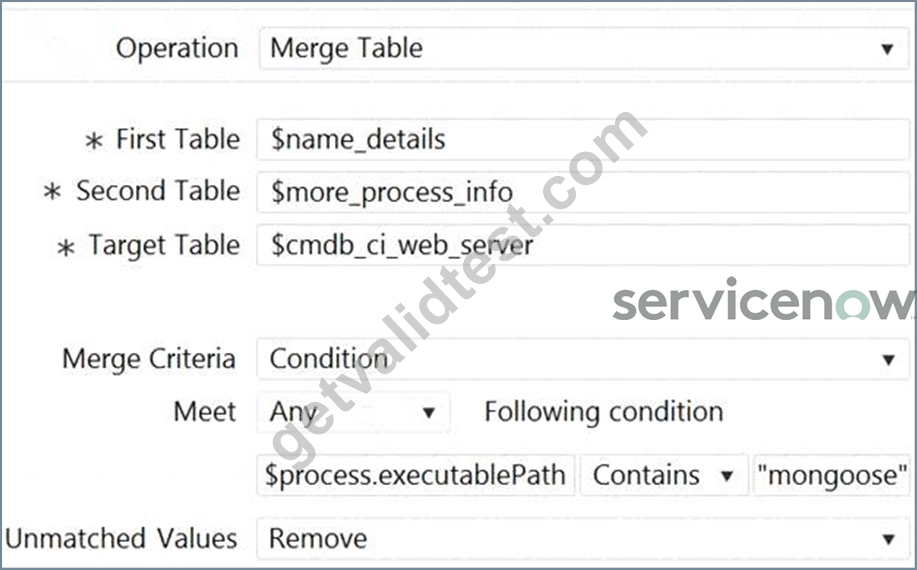
Based on this image, which of the following statements are true? (Choose three.)
- A. For this operation to run, there must be some data in the process.executablePath variable.
- B. If a value is unmatched, it is still merged into the Target Table.
- C. This is a horizontal pattern of type "infrastructure."
- D. Attributes from two tables populate a table with the same name as a ServiceNow CMDB table.
- E. This operation is more than likely a part of a step on a pattern set to Application Pattern Type.
Answer: A,D,E
Explanation:
* A is true because the target table $cmdb_ci_web_server is a ServiceNow CMDB table that stores information about web servers1.
* B is true because the merge table operation is typically used for application patterns, which are horizontal patterns that discover applications and their dependencies. The condition on the process.executablePath variable suggests that the operation is looking for a specific application (mongoose) running on the web servers.
* D is true because the merge table operation requires at least one matching field value between the two source tables1. In this case, the process.executablePath variable is the matching field, and it must contain "mongoose" for the operation to run.
References:
* 1: Merge tables - Product Documentation: San Diego - Now Support Portal
* 3: Product Documentation | ServiceNow
* [4]: Discovery Patterns - Product Documentation: San Diego - Now Support Portal
NEW QUESTION # 77
Which choice best describes how to use a Behavior for discovery?
- A. The Behavior checkbox on a CI.
- B. The Behavior drop-down menu on a Discovery IP Range.
- C. The MID Server selection method on a Discovery Schedule.
- D. The Behavior drop-down menu on a Discovery Status.
Answer: C
NEW QUESTION # 78
For the Parse Variable pattern operation, what is required to have two different parsing methods to populate variables?
- A. A tabular and a scalar variable.
- B. Two different Define Parsing selections on the same step.
- C. Two different Debug Mode sessions.
- D. Two different steps.
Answer: D
Explanation:
The Parse Variable pattern operation allows you to extract information from the output of a previous operation and save it in a variable. You can choose from different parsing methods, such as JSON File, XML File, Regular Expression, or Custom Script. To have two different parsing methods to populate variables, you need to use two different steps, each with a different Define Parsing selection. For example, you can use one step to parse a JSON file and another step to parse an XML file. You cannot use two different parsing methods on the same step, as the Define Parsing selection is unique for each step.
References:
* Parse command output: This article explains how to use the Parse command output operation and the different parsing methods available.
* Pattern Designer: Parse Variable - JSON File gives error: This article provides a troubleshooting tip for using the JSON File parsing method.
* Examples of EVAL scripts used in Discovery patterns: This article provides some examples of custom scripts that can be used for the Custom Script parsing method.
NEW QUESTION # 79
Minimum Shazzam Batch Size for a Discovery Schedule.
Response:
- A. 0
- B. 1
- C. 2
- D. 3
Answer: C
NEW QUESTION # 80
What network protocol is needed to discover windows devices and what should be the permissions of the user?
Response:
- A. 1) WMI Protocol with username/password
2) Domain Administrator permission - B. 1) SNMP Protocol with community string
- C. 1) SSH Protocol with username/password, or private key
2) Root or Sudo privileges must be granted
Answer: A
NEW QUESTION # 81
A discovery runs against a Windows Server returning the following attribute values for the first time:
name = WindowsSN1 serial_number = 12321
A subsequent discovery is ran against a different Windows Server returning the following attribute values:
name = WindowsSN2
serial_number = 12321
With only base system CI Identifiers configured, which of the following is true?
- A. Two Windows Server CIs are created, without serial_number values.
- B. Two Windows Sewer CIs are created, with WindowsSN1 AND WindowsSN2 for names.
- C. A Windows Server CI is created, then updated with WindowsSN1 as the name.
- D. A Windows Server CI is created, then updated with WindowsSN2 as the name.
Answer: B
Explanation:
According to the ServiceNow Discovery documentation, the base system CI Identifiers for Windows Server class are name and serial_number. These are the attributes that Discovery uses to uniquely identify a Windows Server CI. If both attributes match an existing CI, Discovery updates that CI. If only one attribute matches, Discovery creates a new CI. If neither attribute matches, Discovery also creates a new CI. In this scenario, the serial_number is the same for both Windows Servers, but the name is different. Therefore, Discovery will create two separate CIs, one with WindowsSN1 as the name and one with WindowsSN2 as the name.
References:
* Create a Discovery CI classification - Product Documentation: Tokyo - Now Support Portal
* Identification rules - Product Documentation: Tokyo - Now Support Portal
* ServiceNow IRE: Identification Rules Explained - Cookdown
NEW QUESTION # 82
In general, Discovery can provide which of the following kinds of application relationships? (Choose two.)
- A. tcp to udp
- B. host to application
- C. application to application
- D. mid server to target
Answer: C
Explanation:
Discovery can provide information about the relationships between configuration items (CIs), including applications and hosts. Application relationships are the connections between applications that run on different hosts or servers, such as web servers, databases, load balancers, etc. Host relationships are the connections between applications and the hosts or servers that they run on, such as Windows, Linux, Unix, etc. Discovery can identify these relationships using various methods, such as probes, sensors, patterns, file-based discovery, etc. Discovery can also create and update these relationships in the CMDB, using the Depends on::Used by or Runs on::Runs relationship types.
References: Discovery Relationship Creation, Application Discovery Mapping Overview, IT Discovery - Application Dependency Mapping
NEW QUESTION # 83
______ are global variables for steps in horizontal discovery patterns.
Response:
- A. System and process
- B. Baseline and system
- C. Computer_system and baseline
- D. Process and computer_system
Answer: D
NEW QUESTION # 84
What would be the best practice if we want to create a pattern to discover a custom application whose port communicates with a different server?
Response:
- A. We should never use Debug in this case.
- B. We should remember to never use port 8080.
- C. We should select Listening Port as the Find Process Strategy.
- D. We should select Target Port and IP as the Find Process Strategy.
Answer: D
NEW QUESTION # 85
Which of the following choices would be best practice when designing steps with operations requiring variables?
Response:
- A. Design for a static environment.
- B. Use hard coded variables.
- C. Create more variables than required.
- D. Query targets for variables.
Answer: D
NEW QUESTION # 86
......
The CIS-Discovery certification exam covers a range of topics such as Discovery Architecture, Discovery Classification, and Discovery Patterns. It also covers the integration of Discovery with other ServiceNow applications such as CMDB, Asset Management, and Service Mapping. CIS-Discovery exam consists of 60 multiple-choice questions, which need to be completed within 90 minutes. The passing score is 70%, and candidates can retake the exam if needed.
To prepare for the CIS-Discovery exam, candidates should have a strong understanding of IT service management principles and ServiceNow Discovery concepts. ServiceNow offers training courses and resources to help candidates prepare for the exam, including e-learning modules, instructor-led training, and practice exams. Additionally, ServiceNow provides a certification study group, which offers a collaborative learning environment for candidates to ask questions, share insights and prepare for the exam.
Topics of Certified Implementation Specialist - Discovery (CIS Discovery) Exam
Discovery Pattern Design
- Operations (i.e. Match, Parse variable, Parse file, Parsing strategies)
- Sections (Patterns, Identification and Connection Sections, Troubleshooting)
- Syntax (i.e. Variables, Attributes, Regex)
- Pattern Designer (i.e. Debug, Steps, Sections)
- Application Identification and Connection
Discovery Configuration
- Discovery Troubleshooting (i.e. Discovery Errors, Duplicates, Credentials)
- Discovery Process Flow (i.e. PCIE Phases, ECC Queue, Status, Discovered Device)
- Discovery Setup (i.e. Behaviors, Clusters, IP Services, Schedules)
Configuration Management Database
- CI Class Manager (i.e. CMDB Health Dashboard, CI Class Manager, CMDB Tables, Reclassification, CMDB Relationships)
- CMDB Identification and Reconciliation (i.e. CI Identifiers, Reconciliation Definitions, Datasource Precedence, CMDB De-duplication)
Discovery Engagement Readiness
- Discovery Solution (i.e. Business Value, Definition, Positioning)
- Operationalizing IT (i.e. MID Server and Discovery Dashboards, Benefits)
- Planning (i.e. MID Server Requirements and Specifications)
Try Best CIS-Discovery Exam Questions from Training Expert GetValidTest: https://troytec.getvalidtest.com/CIS-Discovery-brain-dumps.html